4338.209 · July 28, 2018 AD
Things You Don’t Ask the Walls
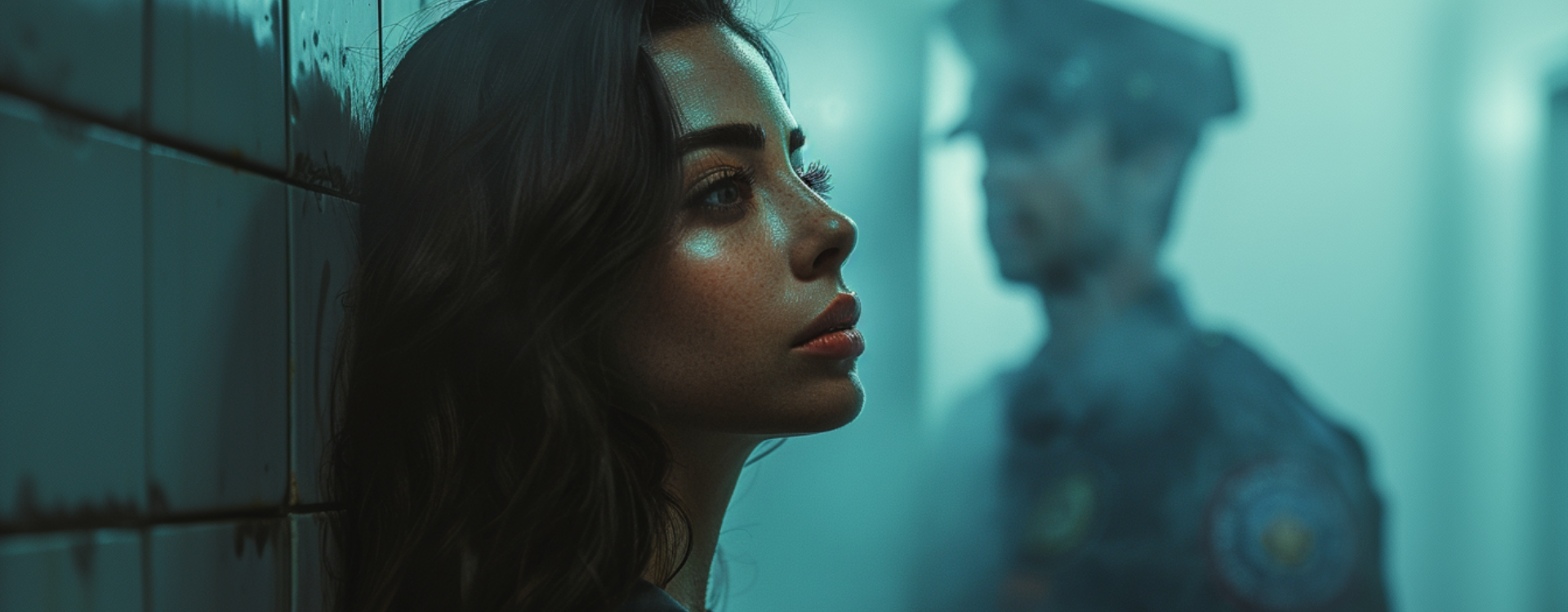
Back at the Hobart station, Sarah pulls the job on like armour, burying the dream and the morning with her grandmother under routine and order. Then Sergeant Claiborne — who watches and delegates but never joins anything — summons her to Interview Room Three, the room kept for the cases that mark you. Whatever is waiting behind that door, every instinct she has tells her it isn’t routine.
"Buildings remember what people won’t. Every silence in a police station has teeth."
I got to the station early, the cold of the morning still in my coat, the disinfectant-and-old-leather smell of the retirement home still in my nose. The dream hadn’t finished with me — it hung about me like a fog that wouldn’t lift, blurring the edges of things, and I wasn’t inclined to look too closely at why. Even now, parked across the street with my hands still on the wheel, I could feel the ghost of that ring, the small pressure of it against my finger, an echo of something that had never been there to begin with.
After Jane had caught me in the wreckage of that dream — the mortification still going through me like something I’d swallowed wrong — I’d done the only thing I knew how to do. I’d fled into work. The promise of order. Of logic. Of control. A world where feelings could be classified, boxed, and filed — preferably in an evidence locker or a confidential report. In here, in the realm of structure and consequence, there was no room for the indulgence of longing or the vulnerability of grief.
The Hobart Police Station loomed ahead, all sharp corners and unforgiving lines, a brutalist slab of damp concrete and municipal despair. In winter the building always looked like it was sweating, a film of moisture sitting on the grey façade as though even the concrete resented the cold. Above it the sky was slate, a low ceiling of cloud pressing down on the city.
Living alone, without even the inconvenience of a houseplant to water or a goldfish to name, suited me — or so I told myself. The lie had been rehearsed for years, worn into a kind of personal truth through repetition and necessity. I’d whispered it to myself while brushing my teeth, while coming home to an empty house at midnight, while standing in front of the fridge weighing up another meal-for-one. Solitude was my armour. No one to disappoint. No one to lose.
My home — if it could be called that — was a modest place in the suburbs, about ten minutes’ walk from the Derwent Entertainment Centre. The sort of street where nobody made eye contact unless they were already holding a rake or a recycling bin. My house didn’t stand out: another low, boxy shape half-hidden behind a weather-beaten fence. Inside it was sparse. Functional. Everything had a place and nothing was sentimental. The only things on the walls were maps — topographic and forensic. The décor spoke in statements, not questions.
It was in that silence, that carefully kept emptiness, that I found something close to peace. No companionship meant no scrutiny, and in the quiet I could breathe. It was also where the obsession lived — the need to solve the unsolvable. A mystery was a puzzle with edges I could define. A case offered a resolution, an ending. The silence behind my own front door offered nothing of the sort; it just sat there, full of the questions I couldn’t, or wouldn’t, ask.
I changed into fresh work clothes, the industrial-detergent smell still on them, and felt the shift begin. The ritual always helped — putting on the job like a coat, letting its straight edges trim away the fuzz of feeling. I was ready to go headlong into the day, ready to drown out the last of the dream. I’d compartmentalised the thing with Jane — filed it for later, for never — and what I needed now was motion. Routine. Something to hold the shape of me in place.
The open-plan office was already going — phones ringing, keyboards clattering, the ancient coffee machine in the far corner choking its way to life. The overhead lights buzzed faintly, throwing everything into that sterile light you only ever get in government buildings and hospital corridors.
My desk sat in the middle of it all, messy and cluttered and entirely mine. Case files, evidence photos, notebooks full of my own chicken-scratch, Post-its curling at the edges — every bit of it part of the working life I’d built. I took a small breath at the sight of it. This, at least, was a world I understood. In here chaos bowed to logic, the truth could be hunted down, and justice — imperfect as it always was — was still something we dared to chase.
"Detective Lahey." The voice cut straight through the noise without rising — precise, cold, already certain it would be obeyed. My body reacted before the rest of me caught up: spine straight, shoulders square, everything pulled tight. There was no mistaking that voice.
I turned.
Sergeant Claiborne stood at the end of the corridor, his height filling the space and blocking whatever moved behind him. He had always taken up more room than his body did — you felt him before you’d worked out why. He never needed to raise his voice to take a room. Standing still and watching was enough.
"Yes, Sergeant Claiborne?" I kept my voice level. Measured. Guarded. Something in me had gone still and watchful the moment he appeared. He had the disconcerting knack of making everything feel like a test, even when the subject wasn’t on any syllabus I’d been given.
He came toward me, slow and deliberate. He was built out of military rigidity — six-foot-three, salt-and-pepper hair cropped to regulation bristle, a jaw that treated smiling as a concept he didn’t quite trust. His face was a latticework of frown lines and professional disappointment. I’d never seen him relax, let alone laugh.
"Are you busy?"
The question was simpler than what sat behind it, and the edge in his voice caught me off guard. There was urgency in it — not loud, but threaded through the flat tone like a warning he hadn’t decided to say out loud yet. His eyes went over me, not with any concern, but with appraisal: a man checking whether a tool pulled from a drawer was still fit for the job.
"Right now, sir?" I echoed, and a flicker of uncertainty got into my voice before I could rein it in. I hated that. The slip. But he always unsettled me — this was too direct, too far off the usual pattern. I went back through recent cases in my head, hunting for the thing I might have missed.
"Yes, right now, Detective."
There was no room in his tone for interpretation. The words came out clean and economical. A small muscle moved at his temple, the only thing in him that gave anything away.
"No, sir," I said slowly, weighing each word. "What do you need?"
It hung there between us, that question, heavier than five words had any business being. The truth was I wasn’t sure I wanted the answer.
"Have you seen Detective Jenkins yet?"
And there it was. Something pulled tight across my shoulders, the old pressure of the things I was keeping and the people I was keeping them for. Karl — my partner in every way that mattered, though Claiborne was none the wiser — was almost certainly still face-down in a dark room somewhere, fighting off last night’s hangover with black coffee and defiance.
His slurred promise came back to me — I’ll be in early, I swear — and I’d known even as he said it that it was a lie. A bit of reassurance we both accepted as theatre.
"No, not yet, sir."
I said it plainly enough, but it came out of me like something I had to push past. A small betrayal, maybe. A necessary one. Claiborne’s expression darkened, his mouth setting into a scowl that drove the creases deeper, the displeasure coming off him without a word.
"You’ll have to join me then."
I blinked. That one I hadn’t seen coming. Join him? Where? Claiborne didn’t run interviews. He didn’t join things. He watched. He delegated. He waited.
My head went through the options fast: a disciplinary? A new case? Some kind of ambush? Whatever it was, it wasn’t routine, and everything in me had gone alert and started looking for the shape of the thing I couldn’t see yet.
He gave me one last look — sharp, dissecting — his eyes narrowing a fraction, as if measuring exactly how much of me he could rely on.
"You’ve got five minutes," he said, voice clipped and decisive. "Then I want you to join me in interview room three."
"Yes, Sergeant," I said, keeping my voice level, though my pulse had already started its climb. He turned and walked off, his heels coming down hard and even on the linoleum, ticking off the seconds before I’d have to follow.
I stood there a moment, watching him go. The smell of stale coffee and bleach came back into my lungs, sharp and real. My desk, my notes, my comfortable chaos — none of it mattered now.
Interview room three.
It was never used lightly. Room one was for the major suspects, room two for the day-to-day. Room three was for the cases that left fingerprints on your soul. Whatever was waiting behind that door, it wasn’t routine.
