4338.205 · July 24, 2018 AD
The Polite Lie
A simple errand spirals into quiet unease when Gladys visits an old friend’s home—only to find a closed door, an odd shopping list, and a credit card that shouldn’t be there. As she steps back into the cold, her instincts whisper that something is wrong… but is she ready to know what?
"When someone says, 'Don't worry,' you start worrying. But when they say it twice, you check the locks."
The chilly morning air of Hobart nipped at my cheeks as I pulled into the driveway of Jamie and Luke's Berriedale house — a sharp, bracing cold that slipped beneath the collar of my coat and got straight to work. A typical July morning, the heart of winter, the sky a pale, washed-out grey that made you wonder if the sun had simply given up.
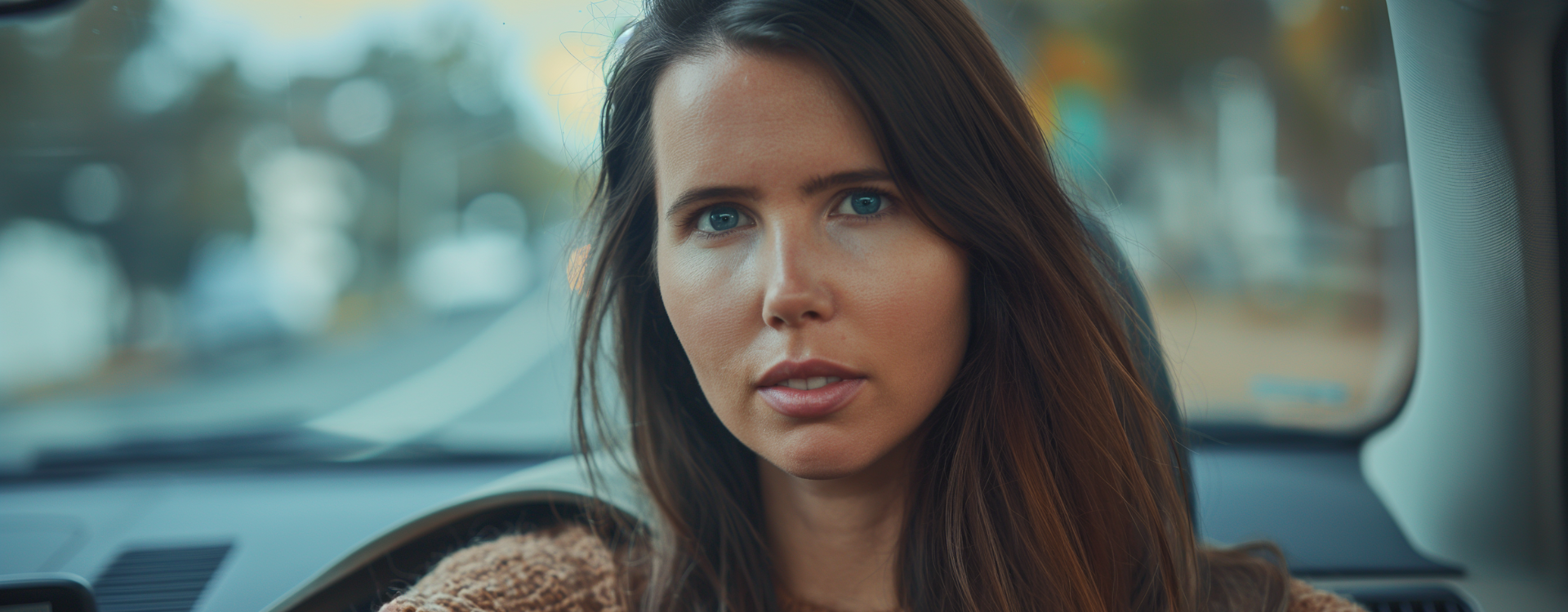
I parked, the dashboard still humming with the last of the heater's warm air. It had been my little sanctuary for the short drive — well, sanctuary might be too strong, but at least it didn't demand conversation. The windows were fogged at the corners, the radio muttering the tail end of a traffic report no one was listening to.
Beside me on the front seat lay the bottle of shiraz I'd brought. "Don't you go anywhere," I told it, my breath clouding in the cold. Half in jest, half in earnest. "I may still need to come back for you yet." There was a strange comfort in saying it aloud — a little pact between me and the wine. I bring you in if it goes well; I retreat to you if it doesn't.
I reached into the back seat for the large plastic container, its emptiness a reminder of the cheesecake it had once held. A noble end, really — if you're going to go, go as something unforgettable. My fingers were already half numb around it, the cold finding its way through my gloves, the stiff plastic biting through the thin fleece as if it knew exactly where to aim.
I stepped out, the winter air greeting me properly now, no longer filtered through a cracked window or the fading heat of the vents. My breath puffed and trailed behind me as I shut the door with my hip. Eucalyptus and chimney smoke — the familiar notes of a Tasmanian winter morning.
My boots crunched on the frost-covered driveway, each step leaving a delicate print in the brittle surface. Oddly satisfying — like cracking the top of a crème brûlée, if crème brûlée were paved and liable to break your hip when you weren't careful.
I made my way to the front door, the container under one arm, wine left behind but not forgotten, and gave three solid knocks. There was a pause — the kind that always seems longer on a doorstep — long enough for the cold to creep into my knees before the door opened.
Luke opened the door and the warmth came at me all at once, heavy with coffee and toast and the floral tang of whatever diffuser Jamie insisted wasn't overpowering (it always was). My bones sighed.
And there was Duke, their white-and-brown Shih Tzu, already vibrating at the sight of a visitor the way only a small dog can — joy with no second thought on it, no edit. I couldn't help but smile.
"Duke!" The cheerfulness was out of me before I'd decided to be cheerful. "Hello!" And in a way he was an old friend. These little furry con artists have a way of worming into your heart, no matter how often you tell yourself you're not that kind of person.
Luke stepped aside to let me in. I went gratefully, out of the biting air, my boots clicking against the floorboards, soles still dusted with frost. I paused to wipe them, conscious of Jamie's unspoken code about clean floors.
As Luke shut the door, Duke quivered as though he might actually combust from delight. Luke set him down, and with the chaotic energy only a small dog can muster — equal parts determination and fluff — he shot off to his toy box.
He rummaged a moment — snout buried, hind legs braced — before triumphantly retrieving his prized Horsey, which was almost comically as long as he was. The faded yellow felt had seen better days, one stitched eye dangling by a thread. He trotted back with his tail wagging proudly, presenting a freshly hunted trophy. If Horsey had ever had dignity, it was long gone.
"Henri!" Duke's brother, the second of their two Shih Tzus, came to have his head patted. His wag was far less coordinated and no less endearing — a great plumed, feathery thing that swished side to side and took the whole back half of his body with it, so that he rocked from paw to paw like a puppet whose strings had all been loosened at once. I'd seen his excitement get so far ahead of him that his back legs simply gave out, a joyful collapse, as though his love of life exceeded his structural integrity.
"I'm just returning Jamie's cheesecake container," I said, finally turning my full attention to Luke and setting the large square thing on the kitchen bench. A plastic relic of my indulgence, my affection and my habitual procrastination — proof of a long friendship with Jamie, and a rather thinner acquaintance with Luke.
"Oh, thanks. I forgot about that," Luke said easily, moving the container to the sink. Which only made it worse — I felt suddenly childish, caught out returning something months overdue, like a library book with dog-ears and jam on the cover.
"Well, it has been the better part of a year since my birthday," I admitted, going for light and not quite getting there. Jamie had been my closest friend for decades, which somehow made holding on to an empty container that long more embarrassing, not less. Some people return things promptly. I… form emotional attachments.
To deflect from my tardiness, I glanced down the hallway, eyes catching on the closed door at the end. The house was unusually still.
"Where's Jamie?" It came out lower than I'd meant it to. Jamie wasn't just a friend; he was a fixture. He'd held my hair back once in a dim toilet cubicle in Salamanca after one too many cabernets. He'd made me tea with lemon and honey the morning after Beatrix and I had our worst row. That kind of friend — steady as the tide, and about as inevitable.
"He's in bed. He's not feeling well," Luke said. Something in the way he said it — flat, factual — didn't quite sit right.
"Oh no! What's wrong with him?" Whatever had been light in my voice a moment ago was gone. The thought of Jamie sick — Jamie, who could bounce off the walls on an ordinary day — felt wrong, like a lightbulb flickering in a room that had always glowed steadily.
"Not sure. I think it's just a tummy bug." Just a tummy bug. The words didn't land softly; they hovered, awkward and flimsy, trying too hard to do their job.
"I'll just pop my head in and say hello," I said, already stepping towards the lounge-room door. It wasn't nosiness, not really — just the reflex you develop after years of showing up for someone.
"No!" The word burst out of Luke with unexpected force and stopped me where I stood. Not angry — sharp, immediate, like a hand across the chest in a crowd. My body froze, not from fear but because something unseen had shifted: the temperature of the room, the balance of familiarity. Something.
Then, softening, he added, "I think he's asleep. He didn't sleep well last night."
"Fair enough," I said, reluctantly, and went back towards the lounge. Something about the exchange clung to me like static; the doubt landed cold and physical, somewhere under the breastbone. Luke's reaction had been sharp. Protective. Too protective — the kind of protectiveness that makes you wonder what, exactly, is being protected.
Did Luke just lie? The question nestled in the corners of my thoughts like a draught under a closed door. Luke and I had always been cordial, but cordial was the whole of it — an extension of my bond with Jamie, polite the way people are when they love your friend. We weren't close. Which was exactly why I had no baseline for the version of him standing in front of me now.
Something in the exchange put me off sitting down. The couch with its plump cushions and the familiar throw — one corner chewed by Duke — didn't appeal the way it usually did. Sitting felt too still, too settled, when my mind wasn't.
Instead I drifted to the large island bench that marked the boundary between the newly renovated kitchen and the open-plan lounge. The space was all Jamie's taste and Luke's practicality — timber and matte-black fixtures against soft greys and deep green, clean and lived-in. The kind of kitchen that made you want to bake something complicated just to justify its loveliness.
I ran my fingertips along the cool stone of the bench, grounding myself in the texture of it. Even so, under the quiet hum of the house, Luke's sharp "no" went on echoing louder than anything actually in the room.
Luke leaned forward from the other side of the bench, deliberate now, and the air between us seemed to shift gears. He pushed a small piece of paper towards me, its edges curled from handling. I reached for it. Warm from his hands, creased — a note that had already lived in a pocket too long.
"Jamie's planning a new little house project. He's made a list of what he needs. Don't suppose you could do us a massive favour and grab a few things?" The casualness sat oddly against the sharpness of a minute ago. "You know how I hate driving, and he's so excited to get started." It had the lightness of a favour being asked, but there was a press underneath it — a little too smooth, a little too prepared.
I studied the list. "Concrete mix, cement mixer, post-hole digger, mattock," I read aloud, enunciating each one as though saying it might make it less absurd. These were not casual Bunnings bits for hanging a photo frame. The list read like the opening of a backyard apocalypse — or, more likely, a Jamie-sized vision about to be enacted with far too much enthusiasm and far too little planning.
While I was still reading, Luke slid a small plastic card across the bench. "You can use that," he said — casual, with a note under it I couldn't place.
I blinked at it. "What's this?" I picked it up and turned it over — a credit card, smooth and cold. The name Paul Smith embossed on the front caught my eye like a splash of colour in a monochrome room. "Paul Smith," I read aloud, and looked up at Luke.
Why does Luke have his brother's credit card? The question arrived clear and immediate. Luke hadn't mentioned Paul was coming down. It had been a few years since I'd met him, but the memory was vivid — he'd flown in from Broken Hill for Christmas, a dry-humoured man with a warm smile and a fondness for the cheese platter.
Paul and I had clicked almost at once — something easy about him, unpretentious. Within twenty-four hours we'd swapped stories, laughs and, embarrassingly, a Facebook follow. We'd chatted on and off since, friendly but never close: one of those odd digital friendships that manage to be both distant and oddly durable.
Holding his card now felt odd — almost intrusive. A tangible link to someone I hadn't thought about in months, dropped into my morning like a name I'd quietly filed under last year turning up unfiled.
"Paul's come down to visit. Jamie asked him to — reckons Paul can help with the project," Luke said, with a casual normalcy that didn't quite cover what was under it.
"Jamie asked him?" I didn't quite keep it flat. It was common knowledge in our circle that Jamie still held a small grudge against Paul — some minor fallout years back, the kind that lingers more in tone than in words. Jamie inviting him down, and to help with a project, struck me as odd. Not impossible. Just out of character, like seeing a cat play fetch.
I shrugged the suspicion off, for the moment. "Are you sure he won't mind?" It was one thing to help a friend; it was another to hand your wallet to someone you hadn't seen in half a decade.
"Not at all — and you might need this too." Luke scribbled Paul's PIN onto the corner of a piece of paper, tore it off and handed it over. Quick, too quick. People didn't just hand over PINs like that. Not unless there was a reason they wanted it off their hands.
I hesitated. The scrap of paper felt heavier than it had any right to — it pressed against my fingers like a secret I hadn't agreed to keep. "Okay," I said slowly. "Yeah… I guess I can help." I didn't like loose ends, and this whole conversation was starting to unravel at the edges. Better, surely, to stay and tie them off than to leave them trailing.
"Awesome, thanks so much. If you get stuck with anything, give me a call and I'll explain it to the cashier." The thanks came a beat too warm, closer to relief than gratitude.
"Sure, will do." I tucked the card and the PIN into my purse, the leather creaking faintly as if it knew this wasn't entirely above board. And there was a small, guilty thrill to it, I'll admit — shopping with someone else's money, an odd little adventure dropped into an otherwise ordinary day.
My eyes went back to the list, to the rest of it in Jamie's neat looping script: hoe, fork, large charcoal garden shed. More riddle than shopping list. "It's an interesting list. So what on earth has Jamie got planned this time?" His projects were always a source of mystery and, often, entertainment — rarely a dull moment once he set his sights on something, though the outcomes ran more ambitious in theory than in practice. The man had once tried to put in a pizza oven and ended up with a small sinkhole in the lawn.
"I know, isn't it just?" A chuckle, and some of the earlier tension went out of the room with it. "I'm not totally sure what he's up to. He wouldn't tell me. I'm secretly hoping it involves a few chickens." Playful — and under it, real curiosity. For all his practicality, Luke enjoyed the theatre of Jamie's schemes as much as I did, though he was more often cast as the clean-up crew.
I laughed, and the sound came freely. Luke's chickens had stirred up a memory — years back now, still vivid. I'd been sworn to secrecy over Jamie's plan to build a surprise hen house for Luke's birthday, nodded solemnly, promised my silence, and then let it slip a fortnight later in a haze of far too much rosé and an ill-advised charades clue involving feathers. The surprise died on the vine. We'd laughed about it anyway, all three of us — everything gone a bit wrong and nobody much minding.
Still a possibility, I thought, with a private smile. Maybe Jamie was circling back to the old idea, letting it hatch properly this time. Or maybe it was something else entirely.
"So, you'll get the stuff?" The question hung there, hopeful, with a trace of something underneath it — some awareness, maybe, of how strange it all sounded. "I promise I'll get Jamie to tell you what he's up to when you're back," he added. He had a politician's grin: charming, mildly evasive, and just plausible enough to disarm you.
I eyed him, my mind still turning the whole thing over: Jamie sick in bed but plotting concrete foundations; Luke holding his brother's card and PIN; the garden shed and the chickens and who-knew-what-else bundled into one neat list. Something about it didn't sit right. It also wasn't enough to object to. Not yet.
"Sure, I'll get it all for him," I said, and kept the scepticism off it. If nothing else, I could prod Jamie for the truth later — he'd never been much good at keeping secrets from me, even when he tried. Loyalty won out over the instinct to push. For now.
So — cheesecake container returned, and somehow more responsibility leaving with me than I'd arrived with — I headed for the door. My steps echoed in the quiet. There was something eerie about the stillness now. Too clean. Too composed.
I gave Duke and Henri a small wave on the way past, their furry faces lifting from their respective sprawls. They watched me with mild interest, as if they sensed I was off to do something important without quite grasping the intricacies of credit cards and cement mixers.
"Bye, boys," I murmured, and their tails wagged, blissfully unbothered by the errand I was about to run.
Outside, the winter air met me again, sharp against the warmth — and the mild confusion — I was leaving behind. I pulled my coat tighter and glanced up at the pale grey sky. The morning was unfolding in strange ways, and though I had no idea what Jamie was really up to, I had the oddest feeling I was about to find out more than I'd bargained for.
I slid back into the driver's seat and tossed my handbag onto the passenger-side floor a bit harder than I meant to. The thud was sharper than expected, and I winced — half at the sound, half at the tension still coiled in my shoulders.
Whatever it was clung to me like the last traces of a bad dream: something seen and not remembered, only felt. It left a taste behind, the metallic bitterness of old paracetamol dissolving too slowly on the tongue. I sat with my fingers curled round the wheel, running the scenarios, each one blooming into a shape that wasn't catastrophic and wasn't comforting either. Luke's explanations hadn't settled anything; they'd just quieted the noise for a moment, like closing a door on a room you didn't want to clean.
He had handed me Paul's credit card. And the question that kept looping back was the obvious one — where was Paul, and why hadn't he gone shopping himself? Reasonable. And I hadn't asked it. I'd let it slip past like a fish through a broken net.
Should I go back in? The thought hovered, tempting in its simplicity. But something held me there in the cold car — politeness, or not wanting to seem nosy, or, if I was honest, not being entirely sure I wanted the answer.
Reaching to tuck the list away, I paused mid-motion. The shiraz was still there on the passenger seat, its dark glass catching the weak winter light — solid, expected, a small anchor in a morning that had quietly stopped being ordinary.
"Oh, good. You're still here," I told it. It didn't laugh back; it didn't need to. Sometimes saying a thing aloud is enough to let a little pressure off the valve.
I let Jamie's list drop into the open mouth of my handbag, where it settled among the receipts and lip balm and the rest of the daily flotsam, and turned the key. The engine came up in its familiar rhythm, a sound I'd heard so often it might as well have been part of my pulse. Comforting. Predictable.
And still something tugged. A thread I couldn't quite leave alone. I pulled out my phone and let my thumbs do what they wanted — no overthinking, no drafts.
Sorry to hear you don't feel well. Call me when you wake up. G.
I looked at it a moment, then hit send. A quiet offering. A lifeline, if it came to that.

