Salt Lake City, Salt Lake County, Utah, United States
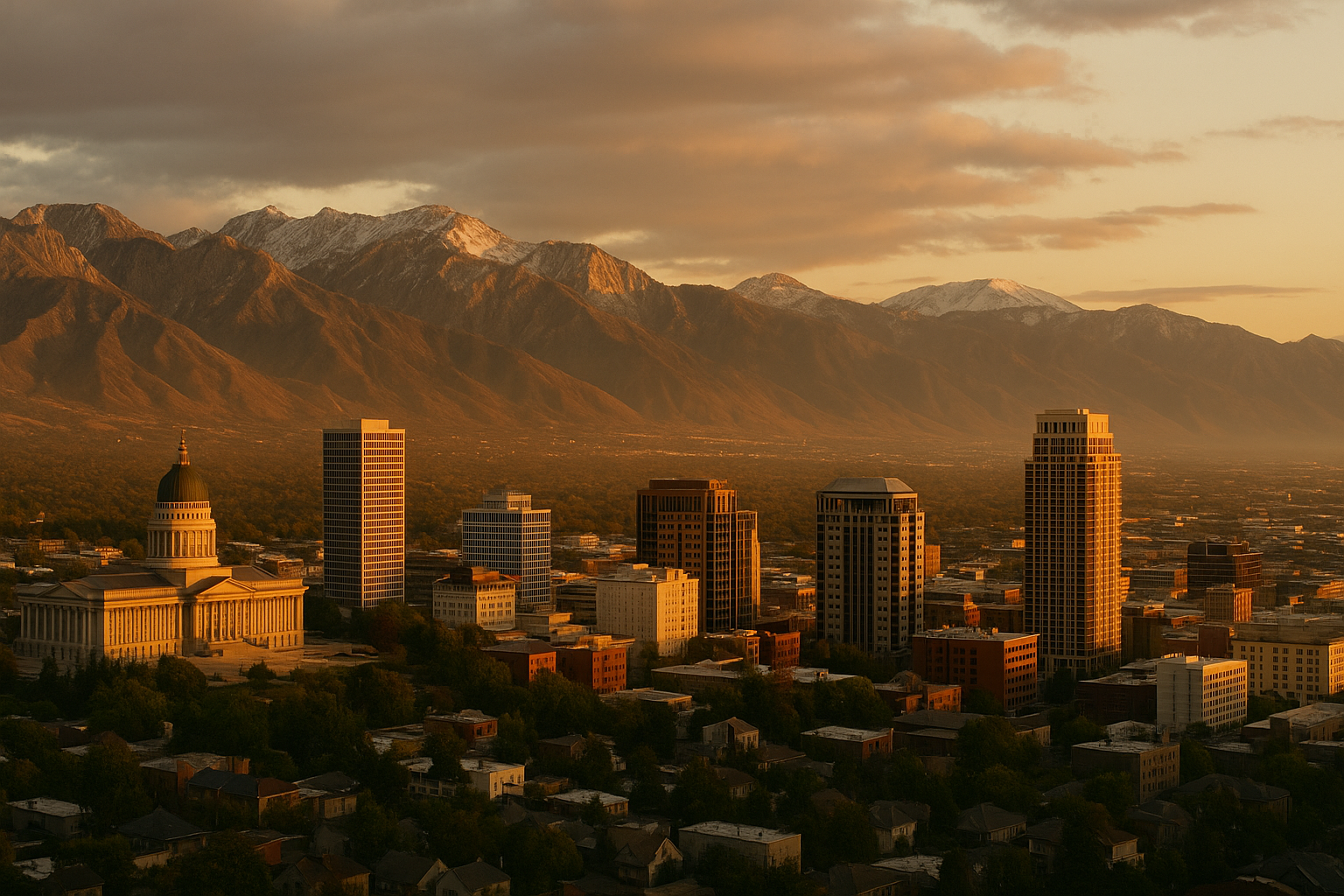
Salt Lake City is the capital of Utah and the largest city in the Salt Lake Valley, a high desert basin ringed by the Wasatch and Oquirrh Mountains. Latter-day Saint pioneers laid it out in 1847 on a grid of wide streets measured from Temple Square, and it remains the headquarters of their Church. Today it is a city of strong contrasts: devout east-side neighbourhoods and diverse west-side ones, ski slopes within half an hour of downtown, winter smog trapped in the valley, and a great salt lake that keeps shrinking.
A Basin Between Mountains
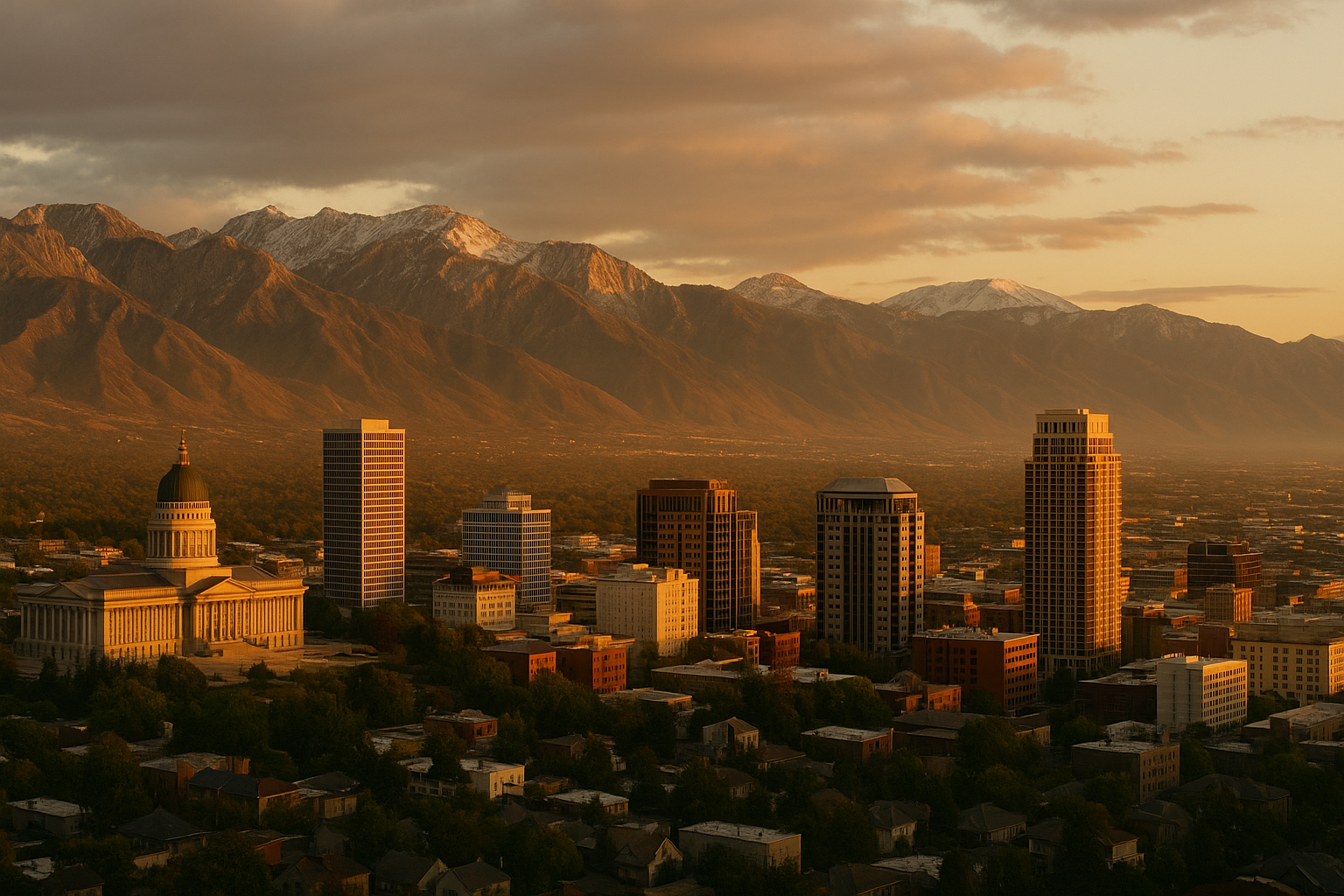
Salt Lake City sits at the north-eastern edge of the Salt Lake Valley, a broad, flat basin more than four thousand feet above sea level. The Wasatch Range rises abruptly along its eastern side, a wall of limestone and granite that catches the weather and holds snow well into the warmer months. The lower and more broken Oquirrh Mountains close off the valley to the west, their flanks scarred by one of the largest open-pit copper mines in the world. To the north-west lies the Great Salt Lake, the shallow, briny remnant of an ancient inland sea, with its mudflats and evaporation ponds.
The terraces cut into the foothills mark the shorelines of that older lake, and they shape the city as much as anything people have built. The oldest neighbourhoods climb the benches below the mountains, while the newer subdivisions spread south and west across the old lakebed. From almost anywhere in the city, the mountains are the first thing a person sees and the easiest way to tell north from south.
The climate is dry and sharply seasonal. Summers are hot, with long glaring afternoons and thunderstorms that build over the peaks and seldom bring much rain to the valley floor. Winters bring snow to the city and far more to the canyons, where storms coming off the lake drop the light, dry powder the ski resorts advertise. Spring and autumn are short and changeable, and it is not unusual for a warm afternoon to end in a snow squall.
The Plat and the Grid
The city was founded in the summer of 1847 by Latter-day Saint pioneers. They had crossed the plains in wagon trains, looking for a place remote enough to practise their faith without persecution. Within days they had chosen a site for a temple and begun laying out the city around it. Their plan followed the vision of a holy city of square blocks, generous lots and broad streets, built for an agricultural people who meant to stay.
That plan still governs the city. Addresses are counted outward from Temple Square in every direction, so that a location reads as a pair of coordinates rather than a street name, and residents give directions in the language of the grid without thinking about it. The downtown streets are famously wide, said to have been laid out so that a team of oxen could turn a wagon without backing up, and the blocks are so large that crossing them on foot takes longer than visitors expect.
Water made the settlement possible. The pioneers dug ditches from the mountain creeks across the alkali flats within their first weeks in the valley, and the gardens and orchards that followed gave the young city its reputation for order and industry. City Creek, which once ran openly down from its canyon through the heart of the settlement, now runs mostly underground, and parts of it have been brought back to the surface as water features and parkland.
Temple Square remains the city's symbolic centre. The granite temple, built over four decades with stone hauled from Little Cottonwood Canyon, stands beside the domed Tabernacle and the visitors' centres. Around them sit the high-rise offices and conference buildings of the Church of Jesus Christ of Latter-day Saints. The Church's headquarters, its administrative centre and its twice-yearly general conferences draw visitors from around the world, and its presence is felt in the city's architecture, calendar and institutions.
Faith, Federal Power and Statehood
For its first half-century the city was both the religious capital of a faith and the political capital of a territory, and the two roles were difficult to separate. The practice of plural marriage and the Church's dominance of civic life brought repeated conflict with the federal government, including a military expedition sent to the territory in the late 1850s. Federal troops were stationed on the eastern bench above the city. Their post, Fort Douglas, overlooked the settlement for decades, a reminder that Washington did not trust it.
The arrival of the transcontinental railroad, completed to the north of the city, ended the valley's isolation and brought miners, merchants and other newcomers who did not share the majority faith. The tension between the Church and these outsiders shaped the city's politics for a generation. Utah entered the Union as a state in 1896 only after the Church formally abandoned plural marriage, and the State Capitol, finished some years later on the hill above downtown, gave the new state a seat of government in grey granite that looks down over the whole valley.
Smelters, Rail Yards and Immigrant Neighbourhoods
Mining and the railroads transformed the city in the early twentieth century. Copper, silver and lead from the surrounding mountains were processed in smelters across the valley, and the rail yards west of downtown became the hub of the regional economy. The work drew immigrants from Greece, Italy, Scandinavia, Japan and Mexico. Many of them settled near the tracks, building churches, coffee houses and boarding houses that gave the west side a character quite different from the orderly residential blocks to the east.
The railway lines, and later the interstate, divided the city into two halves that never fully knitted together. The east side, close to the mountains and the university, became home to established families, professionals and the city's more affluent neighbourhoods. The west side, in districts such as Rose Park, Glendale and Poplar Grove, housed working families, new arrivals and the industry the rest of the city preferred not to see. That divide, in income, air quality, and access to parks and services, remains one of the defining facts of life in the city.
Neighbourhoods on the Benches
The Avenues, climbing the foothills north-east of downtown, is the city's oldest residential district and one of its most distinctive. It breaks from the standard grid: its blocks are smaller, its streets are lettered in one direction and numbered in the other, and they rise steeply enough that winter driving becomes a test of nerve. Its houses are a mix of Victorian cottages, brick bungalows and later infill, set close together under mature trees, with views across the valley from the upper streets. It has long been home to a mix of old Salt Lake families, young couples and those drawn by its walkability and its trails into the foothills.
To the south-east, Sugar House grew up around an early attempt to refine sugar beet and became a busy commercial district of its own, with a large park, a shopping centre and streets of modest post-war houses. Liberty Wells, around the city's largest park, is a neighbourhood of brick bungalows and small apartment buildings. Further south and east, suburbs such as Millcreek and Holladay spread toward the mouths of the canyons, with larger lots, newer churches and long commutes. Each neighbourhood is organised in part around its ward, the local congregation whose meetinghouse sits on many street corners and whose boundaries many residents know better than the city's own.
Hospitals, Schools and the University
The city is the medical and educational centre of a large region. The Church's hospital system grew from a single hospital on the Avenues into one of the largest healthcare networks in the Intermountain West, and Primary Children's Hospital on the university bench treats children from several surrounding states. The University of Utah, spread across the eastern foothills and the grounds of the old fort, is the state's flagship university and a major research institution. Salt Lake Community College serves a broader population of working students across several campuses.
The public school system reflects the city's divisions. West High School, one of the oldest in the state, draws students from both sides of the tracks and has a long history of sport and community pride. Middle and elementary schools such as Bryant and Wasatch serve particular neighbourhoods, and their reputations shape where families choose to buy. The schools are crowded with large families, a legacy of a culture that has long valued children, although the birth rate has fallen steadily in recent decades.
The Modern City
In the late twentieth century the city's economy diversified well beyond mining and the railways. Banking, healthcare, logistics and, more recently, technology firms settled along the Wasatch Front. The stretch of valley south of the city became known for its software companies and start-ups, and downtown filled with new office towers, apartment blocks and a light-rail network linking the city to its suburbs. The city's hosting of the Winter Olympics at the turn of the century brought international attention, new infrastructure and a lasting confidence in its image as a place for the outdoors.
That image is well earned. The canyons east of the city open onto ski resorts, hiking trails and climbing routes within a short drive of downtown. Many residents spend their weekends in the mountains or the red-rock deserts to the south, and outdoor recreation has become as central to the city's identity as its faith. The city has professional sports teams, a symphony, theatre and arts institutions, and a cafe and restaurant culture that has grown far beyond what its reputation suggests to outsiders.
The city also carries real problems. In winter, cold air settles in the basin beneath a lid of warmer air, trapping vehicle and industrial pollution for days at a time in a brown haze that sends people indoors and up into the canyons. Housing costs have risen sharply as the population has grown. The Great Salt Lake has retreated to historic lows, exposing lakebed dust that blows across the valley and threatening the industries and wildlife that depend on it.
A City of Two Temperaments
Salt Lake City has always held two temperaments at once. It remains the headquarters of a worldwide church and a place where faith shapes family life, Sunday routines and the rhythms of whole neighbourhoods. It is also an increasingly diverse and secular city. Members of the majority faith have become a minority within the city limits, its politics lean considerably more liberal than the surrounding state, and many residents keep the Church's culture at a careful distance while still living among its institutions.
That tension rarely becomes open conflict. It shows instead in small ways: the shops that close on Sundays and the ones that defiantly do not, the adult children who stop attending church but still come home for Sunday dinner, and the neighbours who take a meal to a family in need whether or not they share a pew. Ordered and restless, devout and doubting, Salt Lake City is still very much the city the pioneers laid out, and no longer quite the one they intended.