Red Hill, Queensland, Australia
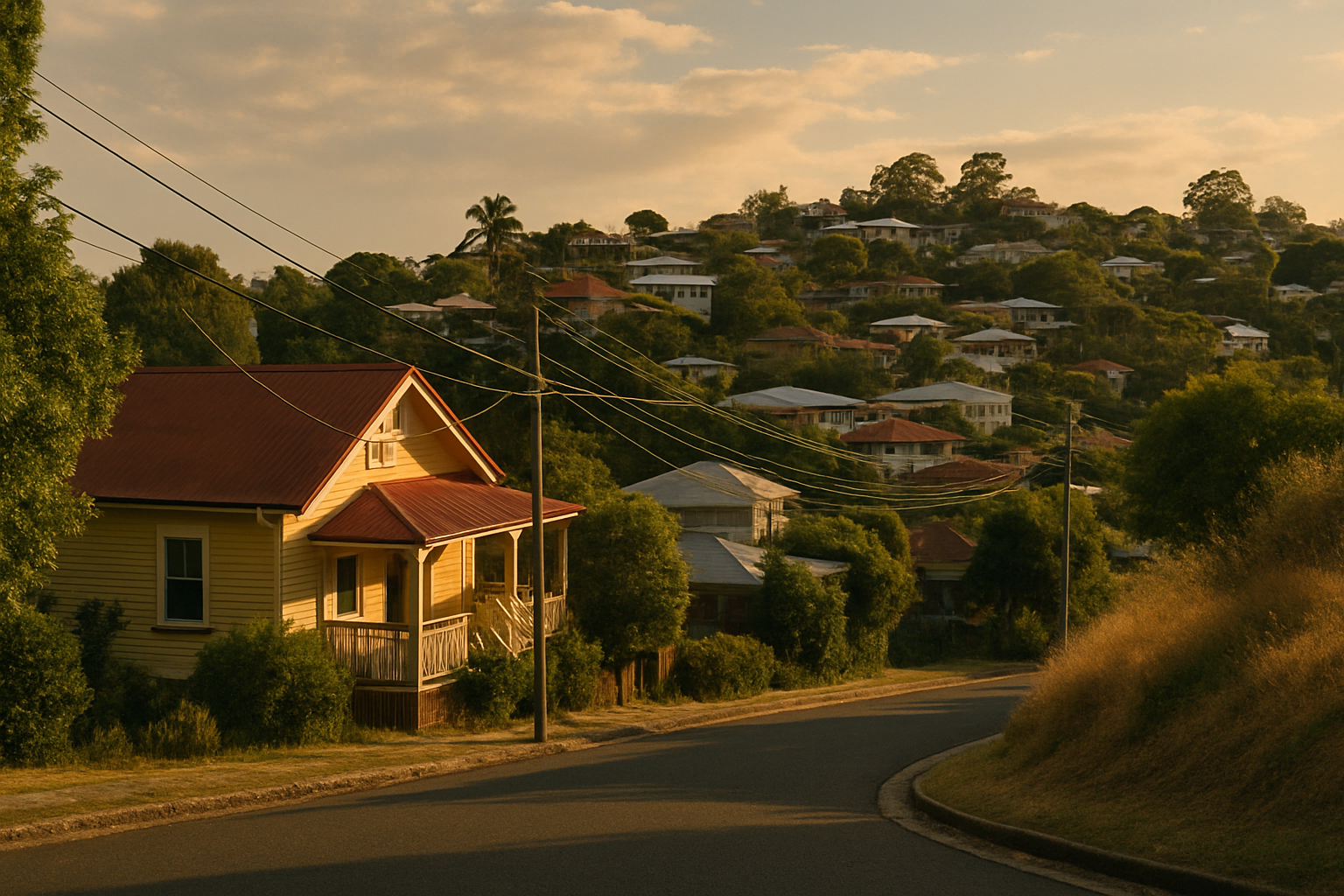
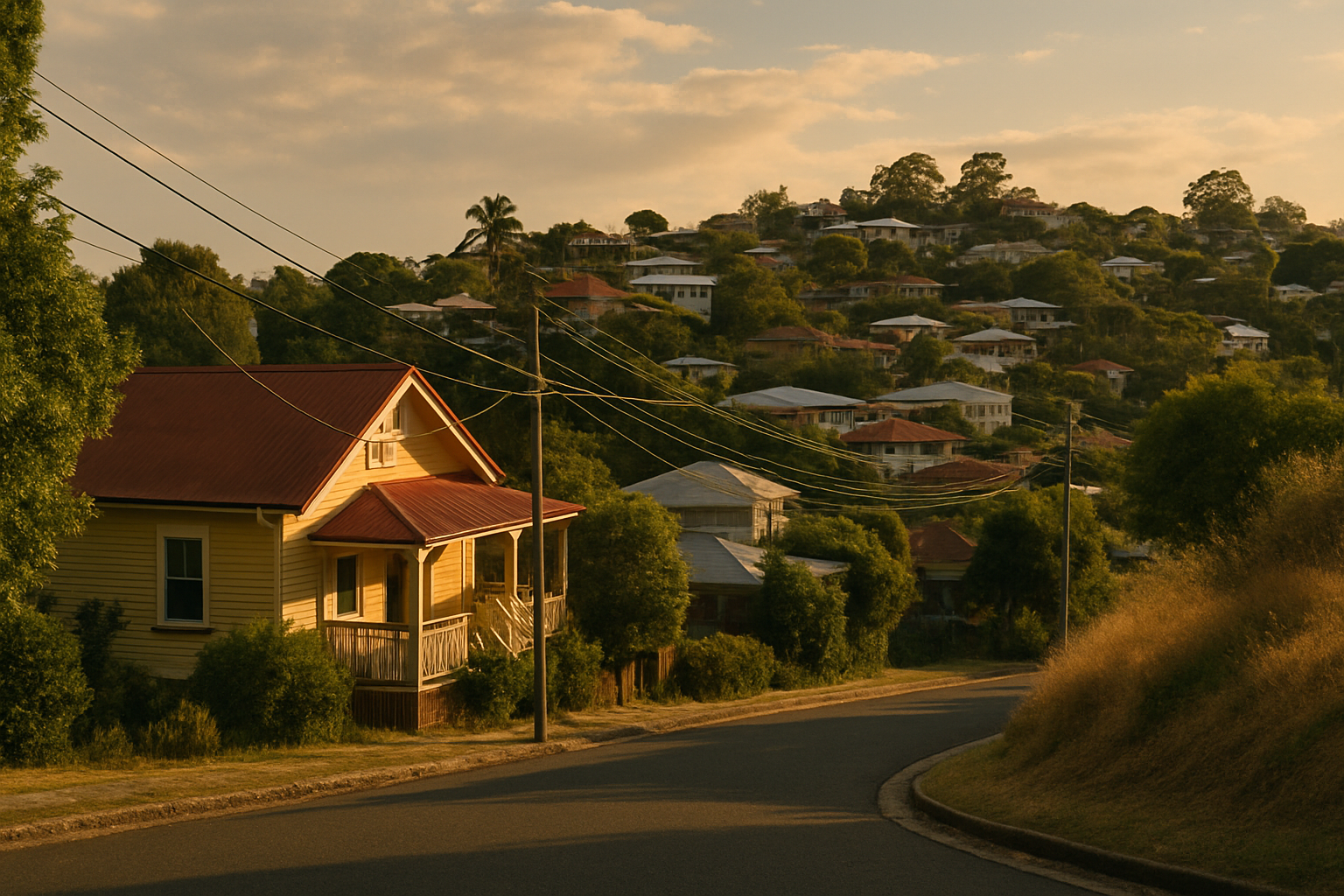
Red Hill climbs a steep ridge north-west of Brisbane's city centre, a suburb of switchback streets and timber houses on tall stumps. It began as Turrbal country above Ithaca Creek and became a district of brick kilns, quarries and dairies. Trams later made it a working-class suburb crowded under the spire of St Brigid's. Its slopes kept developers away longer than flatter suburbs, but did not stop the renovators, the rising rents or the arguments over who the hill belonged to.
The Ridge Above Ithaca Creek
Red Hill occupies a high, broken ridge about three kilometres north-west of Brisbane's city centre. Its spurs fall away steeply to Ithaca Creek on the north and towards Kelvin Grove and Paddington on the south and east. Before European settlement the land formed part of the country of the Turrbal people. The ridgelines served as walking routes between the river and the ranges to the west, and the creek gave water, eels and game. The higher ground looked out over the river valley and the plains towards Moreton Bay.
The suburb's name came from what the first settlers saw when they cleared it. The surface soil of the ridge was rich in iron and weathered to a deep red. Once the timber was cut and the bullock tracks were worn into the slopes, the hill showed raw red scars that could be seen from the town below. The name was in common use by the 1860s, long before the area had any formal standing.
Kilns, Quarries and Dairies
The ridge was too steep and the soil too thin for serious farming, but it held clay and stone, and those drew the first industry. Samuel Trenchard, a Cornish brickmaker who had arrived in Moreton Bay in 1857, opened one of the earliest kilns on what became Enoggera Terrace. He dug clay from the slope behind it and fired bricks for the banks, churches and government offices then going up in the city. Trenchard's kiln worked for almost forty years. The clay pits it left behind were filled with water each wet season and became a hazard for children, and at least two drowned in them before the council fenced the site in the 1890s.
Quarrymen worked the harder outcrops for road metal and foundation stone. Lower down, on the creek flats along Ithaca Creek, small dairies ran a few dozen cows each and carted milk into the town before dawn. The water main from the Enoggera Reservoir, completed in the 1860s, ran down through the district towards the city, and the settlement that grew up along its route was scattered and rough: weatherboard cottages on stumps, perched wherever the slope allowed, with water tanks, wood stoves and long climbs to anywhere.
Ithaca Shire
As population spread out from the town, the district was brought under local government. From 1887 Red Hill formed part of the Ithaca Divisional Board, later the Shire and then the Town of Ithaca. That council governed the ridge and its neighbours until 1925, when the local authorities of the metropolitan area were merged into a single Greater Brisbane.
The Ithaca years were dominated by the expense of the terrain. Every street on Red Hill had to be cut into a slope, drained and retained, and the rates of a working-class district could not pay for it. William Brabazon, a timber merchant who chaired the council for much of the 1900s, fought a long and largely unsuccessful campaign for government money to build the roads. He was remembered locally less for the roads he secured than for the ones he did not. Several of the steepest streets on the ridge remained unsealed until after the First World War.
The coming of the trams transformed the district. The line along Musgrave Road brought Red Hill within a short ride of the city in the early years of the twentieth century. Over the following two decades the slopes filled with houses: modest Queenslanders raised on tall timber stumps at the downhill end and sitting almost on the ground at the uphill end, with verandahs looking out across the valley. Many were built by their owners on weekends, from timber bought on credit.
The Church on the Hill
The building that came to define Red Hill's skyline was St Brigid's Catholic Church. It was completed in 1914 on the crest of the ridge, in red brick with a tall tower, and could be seen from much of the inner city. The parish was large, poor and predominantly Irish-Australian. Its priest for almost thirty years, Father Michael Hennessy, ran a school, a St Vincent de Paul conference and a men's club out of a set of buildings that the parish was constantly in debt for.
Not everyone on the ridge belonged to the parish. Protestant families held their own churches and halls on the lower slopes, and the sectarian divide of the period ran through Red Hill as it did through most of Brisbane: in which shop a family used, which football team a boy played for, and which children were permitted to play together. Hennessy was a forceful man who did little to soften it. The church on the hill served as a landmark for everyone and as a place of worship for some, and the suburb's memory of it was divided along the same lines.
A Working Suburb
Between the wars, Red Hill was a dense working-class suburb of tradesmen, labourers, clerks and their large families. The commercial life of the ridge ran along Enoggera Terrace and Musgrave Road: corner stores, a butcher, a baker, two hotels and a picture theatre that opened in the 1920s on the Terrace and drew audiences from across the northern suburbs on Saturday nights. Rugby league was the dominant sport. The local side played its matches on a ground cut into the hillside below the church, with a slope across the field steep enough to change the game depending on which end a team was defending.
The Depression struck hard. Unemployed men queued at the relief office, families fell behind on house payments, and some lost homes they had built themselves. Agnes Lister, who kept a general store on Enoggera Terrace and served as president of the Red Hill Progress Association through the early 1930s, became the suburb's most persistent advocate. She lobbied the city council for drainage and street lighting, ran a winter clothing drive from the back of her shop, and quietly extended credit to customers she knew could not repay it. The store closed in 1937, by most accounts because of the debts on its books.
The Second World War brought soldiers to the district. The army camp at Enoggera, a short distance to the north-west, expanded rapidly. After 1942 Brisbane filled with American servicemen, and Red Hill's hotels and dance halls drew both. The war years brought money into the shops and rooms let to service families, along with brawls outside the hotels, a curfew enforced by military police, and a long-remembered fight on Musgrave Road in which Australian and American soldiers fought each other in front of the picture theatre crowd.
Post-War Decline and Change
After the war, Red Hill aged. Families who could afford a new house on a flat block in the expanding outer suburbs left for them, and the old Queenslanders on the slopes were let to tenants or sold cheaply. Many lacked sewerage, hot water and indoor bathrooms well into the 1960s. Absentee landlords neglected them, and some fell into disrepair.
Migrant families moved into some of the rented houses, chiefly Italian and Greek, in smaller numbers than in suburbs south of the river. Older residents viewed them with suspicion, and they were frequently charged higher rents for worse housing. Through the 1960s and 1970s developers bought some of the larger blocks, demolished the timber houses and put up low brick blocks of flats. These were cheap, square and hot in summer, and they were disliked by almost everyone except the tenants who could afford nothing else.
The trams stopped running in 1969, when Brisbane closed its tram network in favour of buses. For a suburb whose growth had been built around the line, the loss was felt keenly. The Musgrave Road shops lost much of their passing trade, and several closed during the following decade. The picture theatre on Enoggera Terrace had already gone dark. Its building passed through a series of uses, one of them a roller-skating rink that remained popular with the suburb's teenagers for years.
Renovation and Resentment
From the late 1970s Red Hill was rediscovered. Its closeness to the city, its views and the timber character of its houses drew young professionals, academics and artists who could not afford the established inner suburbs and were happy to take on a house that needed rewiring, restumping and a new roof. Through the 1980s and 1990s the renovators worked their way across the ridge, stripping paint back to the timber, opening up verandahs and building new kitchens and decks into the slopes behind the houses.
The change was not universally welcomed. Rates and rents rose, low-cost rentals disappeared, and the suburb's older working families, many of whom had lived on the same street for three generations, found themselves outnumbered by newcomers. The friction came out in residents' meetings and letters to the local paper. In a feature in the Northern Suburbs Advocate in 1994, Darryl Quinn, a plumber who had lived on Red Hill all his life, complained that the suburb in which everyone had known each other's names was disappearing under a coat of heritage paint. His remark was quoted back at the renovators for years.
Through the 1990s and into the 2000s, however, Red Hill kept a large rental population alongside its owner-occupiers. Many of the low-set and partly renovated houses on the steeper, less fashionable streets were let to young professionals, nurses from the nearby hospitals, teachers, soldiers from the Enoggera barracks, and police officers working out of the northern suburbs stations. They took the suburb for its location rather than its heritage. Their backyards, with decks built out over the fall of the land, hosted barbecues and parties that the neighbours either joined or complained about.
The Creek and the Slope
Red Hill's terrain brought problems of its own. The ridge itself never flooded, but Ithaca Creek did. Intense summer storms sent water down the steep streets in sheets and into the creek, which rose quickly and spread across the low ground along its course. The floods of 1974 and 2011 both reached houses and businesses along the creek. Smaller flash floods came most wet seasons.
The slopes made the suburb difficult in everyday ways. Streets were narrow and often too steep for buses. Parking was scarce, and some houses could be reached only by long flights of steps from the road. Retaining walls failed after heavy rain, and stumps rotted in the wet clay. Residents learnt to judge a house by the state of its stumps before anything else.
Character
By the early twenty-first century, Red Hill had become one of the most sought-after inner suburbs of Brisbane. The cafés and specialty shops of Enoggera Terrace drew customers from across the northern suburbs, and renovated Queenslanders on the upper streets sold for prices their builders could not have imagined. St Brigid's still stood over the ridge, and its tower was still the first thing visible from the city.
The suburb remained more mixed than its prices suggested. Renters, owners and the remaining old families lived side by side on streets where the house on one block had been restored to a showpiece and the house on the next still leaned on its original stumps. The slopes that had kept Red Hill poor for so long also kept it from being flattened and rebuilt, and much of its character survived because its terrain made demolition too expensive. Long-standing residents still argued about whether the suburb had been saved or lost. Newcomers mostly did not know the argument had happened.