James Patrick O'Sullivan
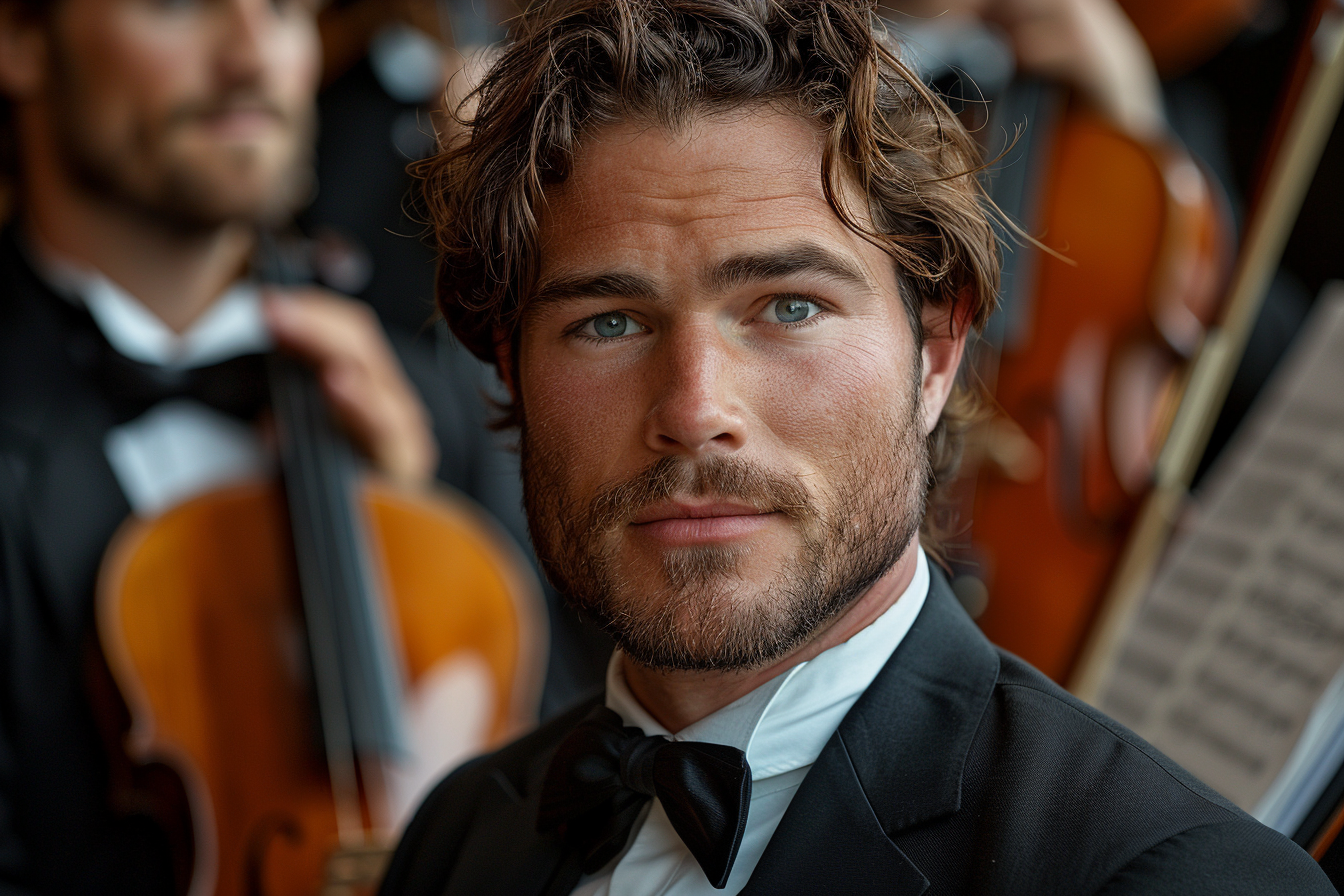
James Patrick O'Sullivan was a Hobart violinist who spent his whole career in the second violins of the Tasmanian Symphony Orchestra by choice. The middle child of a painter and a music teacher, he married his youth-orchestra sweetheart, Emily Thornton, and joined Elizabeth Harris's Tasman Strings in 2010. A fall in the south-west in 2011 nearly ended his playing. He came back, turned to teaching, and kept the quartet going after Elizabeth's death.
The Middle of Three
James Patrick O'Sullivan was born on 12 May 1975 in Hobart, the second of three children of Patrick and Mary O'Sullivan. Patrick was a landscape painter who sold enough canvases to keep the family fed and never enough to stop worrying. Mary taught violin and theory, first from the front room of their weatherboard house in North Hobart and later in the Saturday junior programme at the Tasmanian Conservatorium of Music. The house was Catholic, loud and short of space. Fiona, three years older than James, claimed the back verandah for her drawing table before she was ten. Liam, three years younger, was the one everybody watched. James learned early that the middle of a family was a place where a boy could go unnoticed if he chose, and for most of his childhood he chose to.
Mary put a quarter-size violin in his hands when he was five, because there was one in the cupboard and because she believed every child should be given the chance to refuse an instrument properly. James did not refuse it. He practised in the hallway, the only room without an easel or another child in it, and he practised the way he did most things, patiently and without fuss. His mother was a demanding teacher with her own children and a gentle one with everyone else's. James noticed the difference and did not hold it against her. He understood, even at eight, that she was harder on him because she expected more.
Patrick's studio was a converted wash-house at the bottom of the garden. It smelt of turpentine and wet wool, and James spent long winter afternoons there doing his homework while his father painted the Derwent estuary over and over in different weather. Patrick talked very little while he worked. He taught James, without ever putting it into words, that a thing worth doing was worth doing for its own sake and that most of a working life was spent in rooms where nobody was watching. It was the most useful lesson James ever received, and it came from a man who could not read a note of music.
A Brother Who Played the Cello
Liam took up the cello at six and was better at it by eleven than James was at the violin at fourteen. The family did not pretend otherwise. Teachers came to the house to hear Liam play, and Mary drove him to Melbourne for masterclasses that the household budget could not easily afford. James accompanied his brother in duets at parish concerts and school assemblies, and he discovered that he liked the second part. He liked listening for where the other player was going and arriving there at the same moment. He liked the arithmetic of it, the way a good inner voice held up a melody without anybody noticing it was there.
He was educated by the Christian Brothers at St Virgil's College, where he was neither a scholar nor a sportsman and was left alone by both camps. At fifteen he won a place in the Tasmanian Youth Orchestra, sitting near the back of the second violins, and he found in rehearsal halls the same quiet satisfaction he had found in his father's studio. The youth orchestra also gave him Emily Thornton. She played the flute badly and cheerfully, had joined mainly to escape a dull winter in Kingston, and talked to him during a tea break about the lichen growing on the hall's back steps. He walked her to the bus. They were sixteen, and they did not seriously part again.
Emily gave up the flute within a year and kept James. She was the first person who seemed more interested in him than in his brother, and he never entirely got over the surprise. Her parents were orchardists in the Huon Valley, practical people who regarded a boy with a violin with polite suspicion until he spent an Easter holiday picking apples and did not complain. Patrick painted Emily twice in her late teens. Both portraits hung in the North Hobart hallway for the rest of his life.
Student Years on Davey Street
James enrolled at the Tasmanian Conservatorium of Music in 1993 and studied violin with Dr Ruth Kennerley, an Englishwoman who had played in a London chamber orchestra for twenty years before an advertisement in a professional journal brought her to Hobart. She was blunt, chain-smoked on the Davey Street steps between lessons and had no time for showmanship. She told James in his first week that he would never be a soloist and that this was the best news he would ever receive, because it meant he could spend his life playing music properly instead of selling it. He was not offended. He suspected she was right.
His second year was overshadowed by the review of 1994, when the state government came close to folding the Conservatorium into a larger mainland institution. Students marched to Parliament House with their instruments, and James played the second part of a Bach double concerto on the lawns while a television crew filmed his more photogenic partner. The Conservatorium survived, smaller and poorer, and James learned something about the precariousness of a musical life in a small state that he never forgot. He graduated in 1996 with a sound reputation, a steady technique and no particular ambition beyond earning a living by playing.
Fiona had left for art school in Sydney by then, and Liam had gone to Melbourne on a scholarship at seventeen. For the first time, James was the only child at home. Mary turned to him in ways she had not before, asking his opinion on her students and complaining to him about the Conservatorium's administration. He moved out in 1997, to a rented flat in Moonah with Emily, and the move felt to both mother and son more like a promotion than a departure.
The Second Violins
The Tasmanian Symphony Orchestra took James on as a casual in 1997 and offered him a permanent position in the second violins the following year. He stayed in that section for the rest of his career and never auditioned for anything else. Colleagues who mistook his contentment for lack of ambition misunderstood him. He had looked at the first violins and seen a section whose players were always being measured against the one person at the front. He had looked at the seconds and seen a section that held the orchestra together from the inside. He knew which life suited him.
The orchestra was still playing in borrowed halls when he joined, and the move into the Federation Concert Hall in 2000 was the first time in his professional life that he heard himself clearly from his own chair. He later said the new hall made him a better player in a single season, simply because it stopped him hiding. He toured the island on the orchestra's bus for years, playing school halls in Queenstown and Smithton, and he became known for keeping a thermos of strong tea and a pack of cards under his seat for the long drives through the Central Highlands.
James and Emily were married in 1999 at St Mary's Cathedral, with a nuptial mass that Mary arranged and a reception in the Thorntons' packing shed that Emily arranged. Liam flew home to play a Bach suite during the signing of the register. By then Emily had finished her doctorate in plant taxonomy and taken a position at the state herbarium in Sandy Bay, where she spent her career classifying mosses and lichens from the south-west. Among the collections she worked through were botanical drawings by Margaret Rothschild, whose precise renderings of alpine plants Emily admired long before she knew anything about the family behind them.
A House in West Moonah
Their daughter, Niamh Mary, was born in 2001, and their son, Daniel Patrick, in 2004. The family bought a brick house in West Moonah with a steep garden that Emily filled with native plants and a back room where James practised with the door shut. Money was tight through those years. An orchestral salary in Hobart did not stretch far with two children and a mortgage, and James taught private students three evenings a week to make up the difference. He was a good teacher, unshowy and exact, and his students tended to stay with him for years.
Niamh learned the violin from her father until she was fourteen, when she announced at dinner that she hated it and would prefer to swim. James was hurt for about a week and then relieved, because teaching his own child had felt to him too much like his mother teaching him. Daniel never touched an instrument. He was a practical, restless boy who took engines apart in the shed and wanted to know how boats were built. James and Emily let both children go their own ways, and they were proud of themselves for it, though James sometimes listened to his daughter's abandoned violin in its case and wondered what she might have done with it.
Liam's career, meanwhile, had gone as everyone predicted. He joined a Melbourne orchestra's cello section in his early twenties, won a principal's chair at thirty and recorded for the radio. The brothers were affectionate on the telephone and awkward in person. At Christmas in North Hobart they played duets for their parents, and both of them noticed how readily James still took the lower part.
Sunday Nights in Sandy Bay
When Elizabeth Harris returned from London in 2004 to join the orchestra's first violins, James knew her by reputation and then by sound. By 2007 she was concertmaster, the youngest the orchestra had appointed, and in early 2010 she asked James to join a string quartet she was forming with the violist Amelia Harrington and the cellist Thomas Andersen. James was thirty-four and had long since stopped expecting anyone to ask him to do anything new. He took a week to think about it, mostly because he had no idea how he would find the time, and then said yes.
The quartet rehearsed on Sunday nights in the music room of Elizabeth's father-in-law, Robert Harris, the retired violinist whose house in Sandy Bay had hosted informal chamber music for decades. Robert gave them his own old parts, softened by forty years of pencil markings, and sat in an armchair during rehearsals saying very little until something went wrong. James liked him at once. Robert had spent his own career in the orchestra without chasing the solo platform, and he recognised in James a player who understood what the inner voices were for. Their first public engagement, a lunchtime recital in a church in Battery Point in May 2010, drew twenty-three people.
There was one complication James did not anticipate. Liam, who had been thinking about moving home to Tasmania, had hoped Elizabeth might ask him to be the quartet's cellist. He had never said so to her, and she had no reason to know it, but he said so to James on the telephone after hearing the news. James found himself in the old position of being the less gifted brother who had been chosen, and for months the calls between them were short. It took Liam's own marriage, and a long conversation on the beach at Kingston the following summer, before the matter was laid to rest.
The Fall in the South-West
James had walked in the south-west since his student years, usually alone, in the conviction that a man who spent his working life in rooms full of people needed somewhere entirely empty to go. In the summer of 2011 he set out on a solo walk in the Western Arthurs. On the third day, descending a wet slab of quartzite in poor visibility, he slipped and fell several metres onto broken rock, landing with his left hand trapped beneath him. He activated his personal locator beacon and waited six hours in the rain before a rescue helicopter reached him.
The surgeons at the Royal Hobart Hospital rebuilt the bones of two fingers and repaired tendons across the back of the hand. They told him he would recover ordinary use of it. They did not tell him he would play again, and he understood the omission. For most of that year James did not play at all. He sat through physiotherapy, squeezed putty, sat in on Sunday nights while the other three read string trios, and went home to West Moonah to sit in the dark. He stopped teaching, stopped walking and for a time stopped speaking much to anyone.
Emily carried the household through that year, and the marriage came closer to breaking than either of them later admitted to their children. She found him a psychologist and drove him to the first three appointments herself. Elizabeth visited every week, sometimes with her violin and sometimes without, and never once asked him when he would be ready to come back. Robert Harris sent him a pencilled copy of the second-violin part of a Haydn quartet with a note that said simply that it would keep. The quartet kept his chair empty for the whole of the waiting year.
Beethoven in Launceston
By the end of 2011 James could play scales again, slowly and with pain. He worked for months on the Beethoven violin concerto, a piece he had loved since childhood and never imagined performing, because he wanted something large enough to measure the hand against. Early in 2012 he played it as soloist with the orchestra in Launceston. It was not a flawless performance. The left hand tired in the finale and the intonation slipped in two places that only the players around him noticed. The audience stood anyway, and Ruth Kennerley, who had driven up from Hobart, told him afterwards that it was the first time she had heard him play as if he meant it.
He returned to the quartet that spring and to the orchestra's second violins soon after. The hand never fully recovered. It ached in cold weather and stiffened in long rehearsals, and he adapted his fingering in ways that only a violinist would notice. He also came back changed. He began teaching at the Conservatorium as a sessional lecturer and gave masterclasses for young string players across the state, and he spoke to his students more openly than most of their teachers about fear, injury and the long dull work of recovery.
Weddings, Funerals and Pachelbel
The Tasman Strings lived, as most quartets in small cities do, on weddings and funerals. James kept a running tally in the back of his diary of every wedding at which they played Pachelbel's canon, and he read the total aloud at rehearsal each New Year's Eve. The list became one of the quartet's private jokes, and couples who asked for anything else were remembered fondly for years. When Amelia married Nathaniel Harrington in 2012, the quartet could not play without her, and James helped Elizabeth find a borrowed violist so that Amelia could walk down the aisle to her own colleagues.
The quartet recorded Southern Echoes and, in 2020, Nightfall, and took part in Songs of Country, a collaboration with Aboriginal musicians that James considered the most important thing the four of them ever did. He was the quartet's quiet organiser. He kept the diary, rang the venues and drove the van, and when Amelia's tendinitis kept her out for most of 2016 he was the one who found the guest violists and kept the bookings alive. The quartet played the MONA gala in July 2018 and toured schools across the island, where James's gift for explaining what the second violin did made him the children's favourite.
His father's eyesight failed in his last years, and Patrick O'Sullivan died in 2020, during the first winter of the pandemic, with only ten people allowed at his funeral. The quartet could not play at it. James played a solo Bach sarabande instead, standing beside the coffin with his left hand aching in the cold church, and afterwards he took his father's last unfinished canvas of the estuary home to West Moonah and hung it above his music stand.
The Night the Telephone Rang
In November 2023 the quartet played an early set at a housewarming party at Jeffries Manor, music for the guests' arrival before a jazz trio took over the ballroom. James remembered it chiefly for the drive home, with Elizabeth in the passenger seat talking about repertoire for the coming year. It was the last major engagement the four of them played together.
On the evening of 15 March 2024, a little after nine o'clock, Thomas Andersen rang James to tell him that Elizabeth had been killed in a road accident north of Kempton on her way home from Launceston. Thomas rang Amelia straight afterwards, and James sat in the kitchen in West Moonah with the receiver still in his hand until Emily took it from him. He did not remember afterwards a word of what Thomas had said. He played at Elizabeth's funeral at St David's Cathedral eleven days later, beside an empty chair, and then put his violin in its case and did not take it out again for some weeks.
The quartet did not formally disband. It simply stopped. For more than a year the three surviving members saw each other in the orchestra and spoke about almost anything except playing together. James went back to the south-west that winter for the first time since his fall, with Daniel walking beside him, and found that he could bear the empty places once more provided he was not alone in them.
The Chair That Stayed Empty
Robert Harris died in July 2025, and the quartet played at his funeral at St David's with Hannah Varga, the orchestra's associate concertmaster, as guest first violin and Daniel Harris at the Steinway. It was the first time the three survivors had played together since Elizabeth's death. Hannah did not try to sound like Elizabeth, and James later said that was the only reason it was possible. After the funeral the quartet resumed occasional engagements with Hannah as their guest, always billed as a guest, at Amelia's insistence and with James's agreement.
From 2026 the quartet rehearsed in Daniel Harris's teaching room at the family house in Sandy Bay, in the room where Robert's armchair still stood. On Sunday nights the three of them coached the young players holding the fellowship established in Elizabeth's name, and James found in the work much of what he had once found in Robert's silences. He was more patient with the fellows than he had been with his own students in his thirties, and less inclined to tell them what to feel.
By the end of 2026 James was fifty-one and still in the second violins of the orchestra, though he had reduced his contract and was teaching more than he played. His left hand ached in the Hobart winters and he had stopped pretending that it did not. Emily had become curator of the herbarium's moss collection. Niamh was working as a physiotherapist in Dublin and rang home on Sunday mornings, and Daniel had finished a boatbuilding apprenticeship in Franklin. Mary O'Sullivan, nearly eighty, still lived in the North Hobart house and still asked James for his opinion on her last few students. He still walked in the south-west each summer, though never again alone.