Harding Residence, Hobart Town
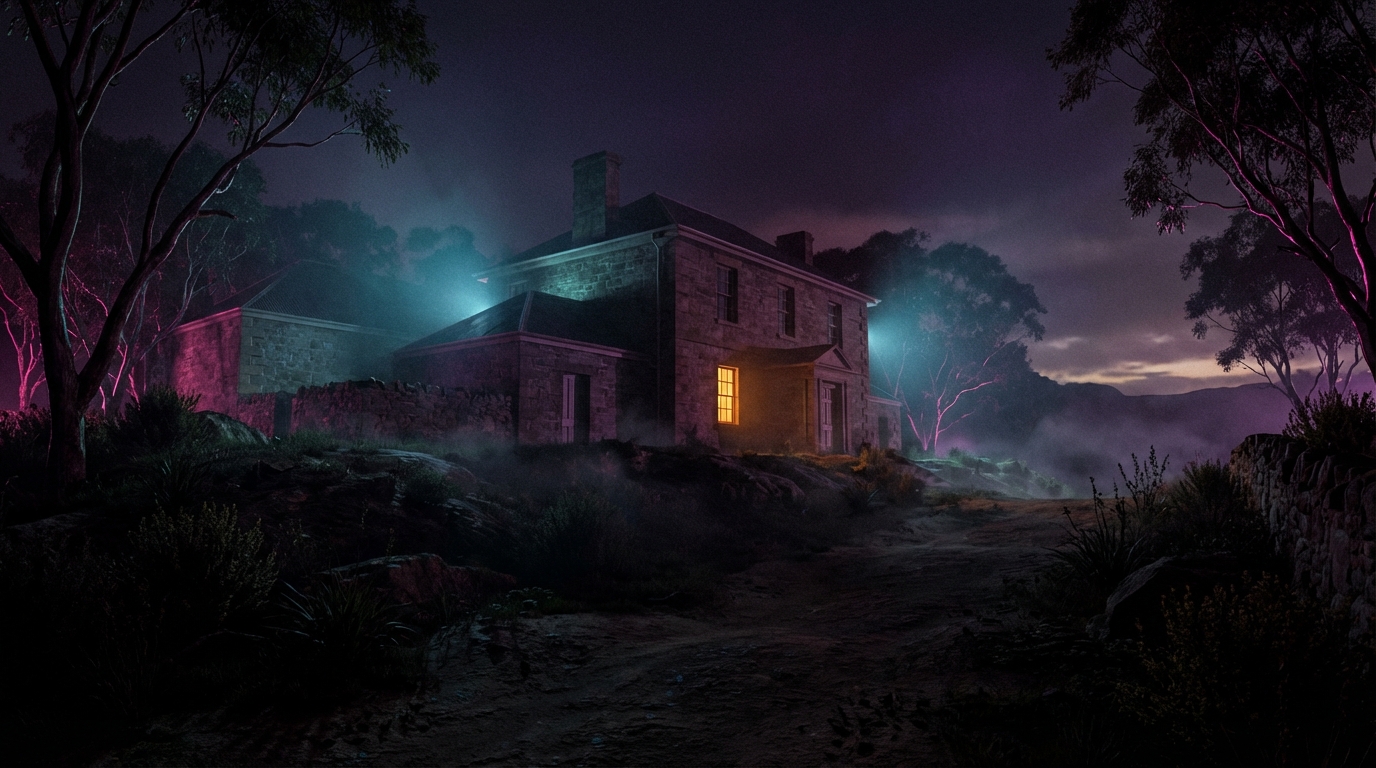
The Harding Residence stood on elevated ground above Sullivans Cove, commanding views across the infant settlement of Hobart Town to the waters of the Derwent beyond. Constructed by the Reverend Robert Knopwood during 1814–15 and acquired by the newly-arrived magistrate Sir William Harding upon his arrival in August 1815, the house represented an ambitious statement of civilised refinement in a colony that remained, by most measures, barely civilised at all. The residence stood for nearly two decades as a centre of respectable society in Hobart Town, hosting magistrates, merchants, and colonial officials who sought the imprimatur of Harding hospitality. Following Sir William's death in 1824 and Elizabeth's marriage, the property passed through several hands before fire gutted the building in 1831. The site was subsequently acquired by Captain Andrew Haig, who erected the Georgian townhouse known as Narryna on the foundations of what had been the Harding garden, ensuring that something of the original property's elevated dignity persisted into the colonial era that followed.
Location and Setting
The residence occupied a parcel of land on the eastern slope of what would later become known as Battery Point, positioned along the route that colonial surveyors would eventually designate Hampden Road. The site had been part of the original thirty-acre grant made to the Reverend Robert Knopwood in 1805—the first residence established outside the military camp that comprised Hobart Town's earliest settlement. By 1814, financial difficulties had forced Knopwood to consider disposing of portions of his grant, and it was upon this elevated parcel that the chaplain constructed the residence he would sell to Harding the following year.
The position was carefully chosen. Elevated perhaps sixty feet above the waterfront, the site offered commanding views across Sullivans Cove to the eastern shore of the Derwent and the hills beyond. In an era when Hobart Town remained a scattered collection of crude structures huddled along the waterfront, such elevation conferred both practical and symbolic advantages—distance from the noise and odours of the settlement's commercial activity, protection from the flooding that periodically inundated lower-lying areas, and a visible statement of status that placed the magistrate's residence literally above the common run of colonial habitation.
The land itself sloped gently from the road toward the cove, allowing for the establishment of gardens that would, in time, become one of the property's distinguishing features. Knopwood had cleared the native vegetation and established basic plantings, but it was Elizabeth Harding who transformed the grounds into something approaching English refinement—roses and lavender grown from cuttings she had carried from the gardens of Bath, fruit trees that would eventually yield apples and pears suited to the Tasmanian climate, a kitchen garden that supplied the household with vegetables and herbs throughout the growing season.
To the north, the property bordered land that remained part of Knopwood's diminished holdings, while to the south lay parcels that would eventually be developed as the area transformed from agricultural grants into the residential suburb that Battery Point would become. In 1815, however, the Harding Residence stood largely alone on its elevated site—a solitary outpost of English domesticity overlooking a settlement that had not yet decided what it wanted to be.
Construction and Design
The residence owed its existence to the Reverend Robert Knopwood's perpetual financial difficulties. The colony's first Anglican chaplain had received his thirty-acre grant in 1805, but his fondness for hospitality, hunting, and living beyond his means had left him perpetually short of funds. By 1814, Knopwood had conceived a scheme to ease his debts: he would subdivide a portion of his grant, construct a gentleman's residence upon the most desirable parcel, and sell the improved property to whatever official or merchant might require accommodation suitable to their station.
Construction commenced in the autumn of 1814 and proceeded steadily through the following year, employing convict labour assigned to Knopwood and supplemented by free tradesmen whose skills the chaplain could ill afford but deemed essential. The house was largely complete by July 1815—fortuitous timing, as word soon reached Hobart Town that a new magistrate had been appointed and would arrive before the year's end. Knopwood, who maintained correspondence with officials in Sydney and London, learned of Sir William Harding's impending arrival and recognised opportunity in the coincidence. Here was a gentleman of standing who would require immediate accommodation appropriate to his position, and here was a residence awaiting precisely such an occupant.
The transaction was concluded within days of Harding's arrival on 23 August 1815. The price—never recorded in surviving documents but rumoured to have been generous by colonial standards—allowed Knopwood to satisfy his most pressing creditors while retaining the bulk of his original grant. Harding, for his part, acquired a residence that spared him the indignity of temporary lodgings and allowed him to begin establishing his social position immediately. The dinner party he hosted on 3 September, barely eleven days after stepping ashore, served as both introduction to colonial society and unofficial housewarming—a statement that the new magistrate intended to be a presence in Hobart Town from his first week of residence.
The building itself was modest by the standards of English country houses but substantial for colonial Hobart Town. Two storeys in height, constructed primarily of locally-fired brick with rendered exterior walls, the residence presented a symmetrical Georgian façade to the road—five bays across, with the central bay containing the main entrance beneath a simple but elegant fanlight. The roof was hipped, covered with wooden shingles that would require replacement several times during the building's existence, and punctuated by four chimneys serving the fireplaces that heated the principal rooms.
The ground floor contained the public spaces essential to a magistrate's social obligations. The entrance hall, some fifteen feet in length, featured a staircase rising to the upper floor and doors opening to rooms on either side. Wallpaper in a fashionable stripe of cream and pale green—shipped from Sydney at considerable expense—covered walls that might otherwise have revealed the roughness of colonial plastering. Brass fixtures, polished to a high lustre by servants whose labour made such refinement possible, caught the candlelight and threw it back in warm cascades.
To the left of the entrance lay the drawing room, the largest and most carefully appointed space in the house. Perhaps thirty feet in length and twenty in width, with tall windows along the eastern wall offering views across the cove, this room served as the setting for the social gatherings that constituted much of a colonial magistrate's unofficial business. A substantial fireplace dominated the far end, its ornate brass guard protecting guests from sparks while contributing to the impression of English domesticity transported across twelve thousand miles of ocean.
To the right of the entrance lay the dining room, smaller than the drawing room but no less carefully appointed. A table capable of seating twelve occupied the centre of the space, surrounded by chairs whose mahogany gleamed with the attention of servants who understood that their master's reputation rested partly on such details. A sideboard along one wall held the silver and crystal that distinguished formal dining from mere eating, while portraits—ancestral faces brought from England to remind the household of connections that distance could not entirely sever—looked down from walls painted in a deep burgundy.
The upper floor contained the private spaces: bedchambers for Sir William and Elizabeth, a small sitting room that served as Elizabeth's private retreat, and additional rooms that accommodated guests when overnight hospitality was required. The servants' quarters occupied a separate structure at the rear of the property—a single-storey building of rougher construction that housed the cook, the housemaid, and the various convict assignees whose labour maintained the household's operations.
The Household
Sir William Harding arrived in Hobart Town on 23 August 1815, accompanied by his daughter Elizabeth and a small retinue of servants whose willingness to venture to the opposite side of the world spoke either to exceptional loyalty or exceptional desperation. His wife, Lady Caroline Harding, had remained in England—her health, it was said, could not survive the voyage, though rumours suggested other reasons for the separation that polite society chose not to examine too closely.
The household that established itself in the new residence on the slopes above Sullivans Cove was therefore unusual by the standards of colonial domesticity: a widower in all but name, a daughter who assumed responsibilities that would normally have fallen to a wife, and a staff whose composition shifted as convict assignees came and went according to the unpredictable rhythms of the assignment system.
Elizabeth Harding, twenty-three years old upon her arrival in the colony, became the effective mistress of the household from its first day of operation. She managed the servants, planned the menus, arranged the social calendar, and performed the countless small acts of hospitality that transformed a house into a home suitable for entertaining. Her competence in this role surprised those who had expected a young woman of her background to be overwhelmed by colonial conditions; her intelligence in executing it surprised those who had assumed that social management required nothing more than attention to domestic detail.
The servant staff fluctuated over the years but typically included a cook—usually a free woman whose skills commanded wages that convict labour could not match—a housemaid responsible for cleaning and general maintenance, and two or three convict assignees who performed the heavier work of gardening, wood-cutting, and stable management. The grey-haired woman who served as senior housemaid during the residence's early years, whose name has not survived in any record, appears in multiple accounts as a figure of quiet authority whose management of the household's daily operations allowed Elizabeth to focus on its social dimensions.
Social Function
The Harding Residence served functions that extended well beyond mere habitation. In a colony where formal institutions remained underdeveloped and official venues for social gathering scarcely existed, private homes assumed public significance. A magistrate's residence, in particular, occupied a unique position—neither entirely private nor entirely official, but something in between that allowed business to be conducted under the guise of hospitality.
The dinner parties hosted at the residence became, within months of its completion, essential fixtures on the colonial social calendar. Invitations were sought by merchants hoping to establish relationships with judicial authority, by settlers seeking favourable consideration for land grants, by military officers whose careers might benefit from civilian connections, by anyone who understood that colonial success depended as much on social position as on individual capability.
The dinner of 3rd September 1815 exemplified the residence's social function at its most characteristic—and most ambitious. Hosted barely eleven days after Harding's arrival in the colony, the evening served as both housewarming and declaration of intent, announcing that the new magistrate would be a force in colonial society from his first fortnight of residence. The guest list that evening brought together figures whose influence would shape the colony for decades: Lieutenant Governor Thomas Davey, whose controversial administration was already attracting criticism from Sydney; Henry Bradshaw, the Liverpool merchant whose networks of connection made him essential to anyone seeking commercial advancement; Douglas Fitzpatrick, whose pastoral holdings in the Midlands represented the new wealth that land and sheep were creating; Silas Croft and William Jeffries, newcomers whose ambitions had not yet found their full expression; and others whose names have faded from historical memory but whose presence that evening testified to their contemporary significance.
What distinguished such gatherings at the Harding Residence was not their format—which followed conventions established in English society and transported largely unchanged to colonial conditions—but their atmosphere. Sir William's particular combination of judicial authority and personal weariness created a setting where guests felt simultaneously observed and strangely free, aware that nothing they said would escape the magistrate's attention yet confident that he had seen too much to be shocked by anything human nature might reveal.
The Gardens
The gardens that surrounded the residence represented Elizabeth Harding's most personal contribution to the property and, in some ways, her most lasting legacy. In a colony where most settlers contented themselves with utilitarian plantings—vegetables for the table, fruit trees for preserving, perhaps a few flowers if time and inclination permitted—the Harding gardens aspired to something more ambitious: a recreation of English horticultural tradition adapted to Tasmanian conditions.
The front garden, visible from the road, presented a formal face appropriate to a magistrate's residence. Gravel paths wound between beds planted with roses—varieties selected for their hardiness rather than their fashionability—and bordered with lavender whose scent perfumed the air on warm summer evenings. A low stone wall, constructed from local sandstone by convict labour, separated the garden from the road while allowing passersby to observe the property's carefully maintained respectability.
The rear garden served more practical purposes. The kitchen garden occupied a sunny corner, producing vegetables and herbs that supplemented the household's reliance on colonial markets. Fruit trees—apples, pears, and quinces that proved well-suited to the climate—provided both fresh fruit in season and preserves for the winter months. A small orchard of cherry trees, planted in Elizabeth's first year and tended with particular care, eventually yielded fruit that became famous among the colony's small circle of discerning households.
But it was the eastern garden, overlooking the cove, that most clearly expressed Elizabeth's vision. Here she created what visitors sometimes described as an English garden transported to the antipodes—a carefully composed arrangement of flowering shrubs, ornamental trees, and perennial borders that offered something in bloom throughout the growing season. A wooden bench, positioned to capture the morning sun and the view across the water, became her favoured retreat for the quiet hours when household duties permitted contemplation.
Decline and Destruction
Sir William Harding died on 17th March 1824, nine years after establishing himself in the colony and the residence that bore his name. His death, though not unexpected—his health had declined steadily in the years following his arrival—nonetheless marked a turning point in the property's history. Elizabeth, who had married Silas Croft in 1816 and established her own household, retained an emotional connection to her childhood home but no practical need for its continued occupation.
The residence passed through several hands in the years following Harding's death. The first purchaser, a merchant named Henderson whose given name has not survived in records, occupied the property for approximately three years before financial difficulties forced its sale. The second owner, a pastoral settler named Carmichael who had made his fortune in the Midlands wool trade, used the residence primarily as a town house for visits to Hobart, leaving it vacant for extended periods and maintaining it with diminishing attention to the standards Elizabeth had established.
It was during Carmichael's ownership, in the winter of 1831, that fire consumed the residence. The precise cause was never definitively established—a chimney fire that spread to the roof timbers, perhaps, or a candle left unattended in an empty room, or simply the accumulated neglect of a property whose absentee owner had allowed maintenance to lapse beyond safe limits. The fire began sometime during the night and had largely consumed the building before neighbours could organise effective response. By morning, only the exterior walls remained standing, and these were so compromised by the heat that they required demolition rather than repair.
Carmichael, who had lost relatively little of personal value in the fire—his primary residence remained in the Midlands—chose not to rebuild. The property sat vacant for several years, its ruined walls gradually disappearing as locals salvaged bricks and stones for their own construction projects, its gardens reverting to the wild growth that colonial conditions encouraged when cultivation ceased.
The Site Today
In 1835, the site was acquired by Captain Andrew Haig, a merchant and shipowner who had made his fortune in the China trade before settling in Hobart Town. Haig recognised the location's advantages—the elevated position, the views across Sullivans Cove, the proximity to the commercial activity of what would become Salamanca Place—and commissioned the construction of a new residence that would eventually be known as Narryna.
The Georgian townhouse that Haig built between 1835 and 1840 occupied roughly the same footprint as the Harding Residence, though its design reflected the more sophisticated architectural aspirations of the later colonial period. Two storeys in height, with a sandstone façade that concealed the brick construction beneath, Narryna presented an elegance that the earlier residence, for all its careful appointments, had never quite achieved.
Whether any physical traces of the Harding Residence survive beneath or within Narryna's structure remains uncertain. The foundations may incorporate elements of the earlier building; the garden walls that still define portions of the property may date to Elizabeth's original design; the elevated terrace that offers views across the cove may preserve the contours that the Hardings knew. But these connections, if they exist, are invisible to casual observation, buried beneath the accumulated layers of nearly two centuries of subsequent occupation.
Narryna today operates as a heritage museum, offering visitors a glimpse of colonial domestic life in the decades following the period when the Harding Residence stood on the same site. Those who walk through its rooms and gardens walk, unknowingly, through spaces that William Jeffries once occupied—that Elizabeth Harding once tended—that Thomas Davey once disrupted with his calculated provocations. The building that shelters these ghosts is not the building they knew, but the ground beneath remains unchanged, holding whatever memories the earth preserves of the lives that passed across it.







