Elizabeth Anne Harris (née Chen)
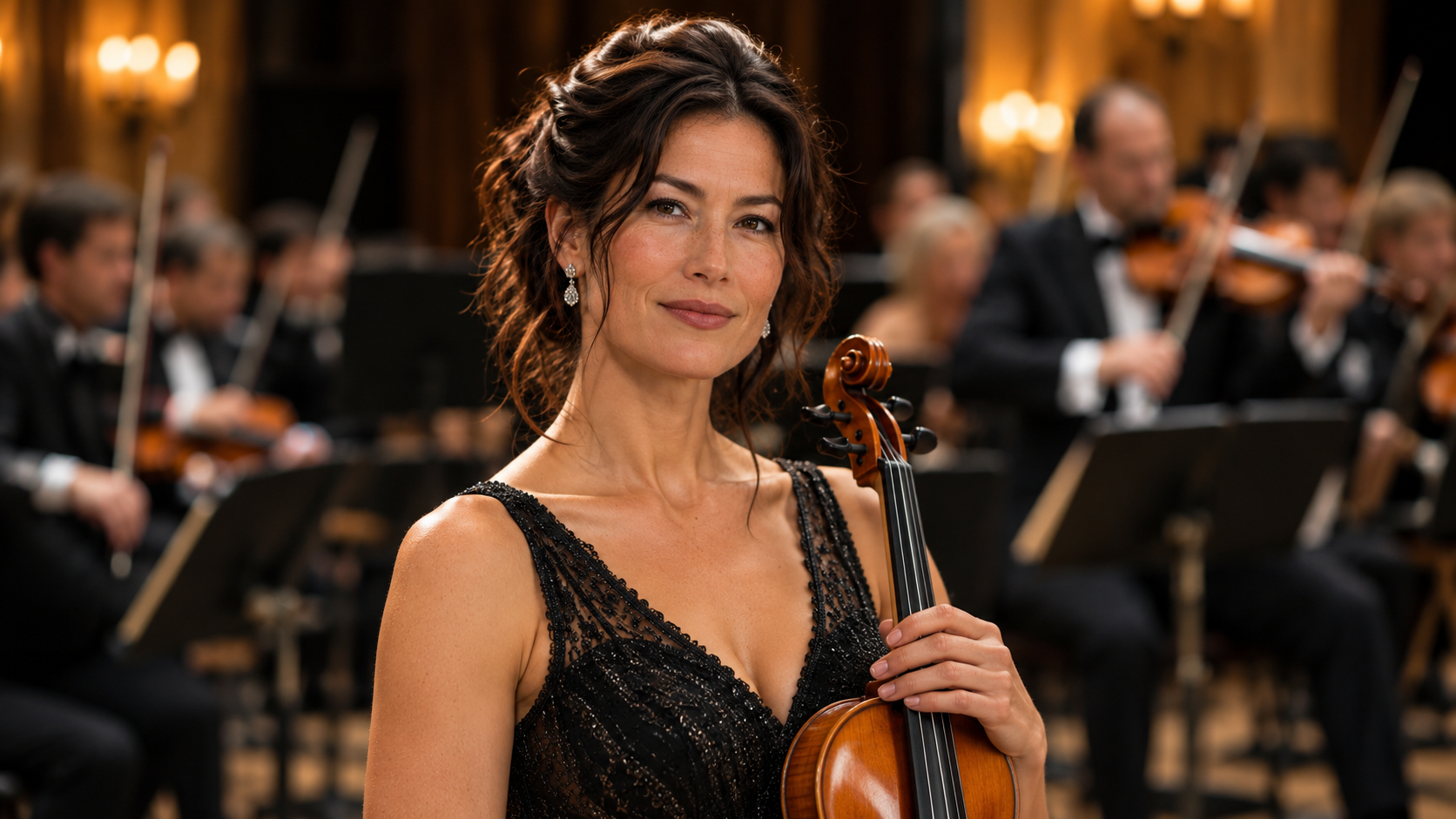
Elizabeth Anne Harris née Chen was born in Hobart on 17 July 1980, the daughter of marine biologist Jonathan Chen, whose family had been in Tasmania since the 1880s tin fields, and painter Margaret Thompson. A violinist trained at the Royal Academy of Music, she became concertmaster of the Tasmanian Symphony Orchestra in 2007 and founded The Tasman Strings in 2010. She married pianist Daniel Harris in 2005 and had two children. She was killed in a road accident in 2024.
Weldborough Tin
Elizabeth Anne Chen was born on 17 July 1980 at the Royal Hobart Hospital, the first child of Jonathan Chen and Margaret Chen née Thompson. Her father's family had been in Tasmania for nearly a hundred years. His great-grandfather, Chen Ah Kee, had come from Guangdong in 1882 to work the tin fields around Weldborough in the north-east, and had stayed when most of the other Chinese miners left. The family moved to Launceston at the turn of the century and kept a greengrocery in Charles Street for three generations.
Jonathan, born in 1950, was the first of the Chens to go to university. He studied science at the University of Tasmania, took a doctorate in marine biology and joined the university's staff in Hobart, where he spent his career studying the kelp forests and reef fish of the island's south-east coast. In 1977 he married Margaret Rose Thompson, born in 1952, a painter from a Hobart family of schoolteachers whose seascapes and shorelines sold steadily in Hobart galleries. The couple bought a house in Taroona with a garden that ran down towards the Derwent.
Elizabeth's brother, Nicholas Jonathan Chen, was born in 1983. He took after his father, and spent his childhood in rock pools and his adult life as a fisheries scientist. Elizabeth took after no one in particular. She was a quick, loud, bossy child who organised her brother, the neighbours' children and her parents' dinner guests, and who could not bear to lose at anything.
It was a comfortable, outdoor, argumentative childhood. Jonathan kept a small aluminium dinghy at the Taroona boat ramp and took the children out on the river at weekends to check his instruments and count fish. Margaret painted in a converted sleep-out at the back of the house and expected the children to amuse themselves. Every few months the family drove north to Launceston to see Jonathan's parents above the old shop in Charles Street, where Elizabeth's grandmother fed them until they could not move and asked her, every visit, when she would stop playing that thing and learn something useful.
Sarah Wellington's Studio
She began the violin in 1985, at five, with Sarah Wellington, an English violinist who had married a Tasmanian and taught from a studio in Sandy Bay. Miss Wellington was patient, exacting and unimpressed by talent on its own, and she spent the first two years trying to teach a gifted, impatient child that a scale played slowly was harder than a piece played fast. Elizabeth practised because she wanted to win. By eight she was winning.
At twelve, in 1992, she played the first movement of the Mendelssohn concerto as soloist with the Hobart Youth Orchestra in the Town Hall. Her father, who rarely showed emotion in public, had to leave the hall at the end. Her mother painted her afterwards in her concert dress, a picture that hung in the house at Taroona for the rest of Margaret's life and that Elizabeth disliked intensely.
She went to St Michael's Collegiate School, the Anglican girls' school in central Hobart, from 1986. She was clever, competitive and not always popular. She was one of a handful of girls of Chinese descent in the school in the 1980s and 1990s, and she learned early to answer a particular kind of question about where she was really from with a short, flat recitation of her family's century on the island. It hardened her. Her friends found her loyal and funny, and the girls she did not like found her frightening.
At fifteen she nearly gave it up. She had grown tired of Miss Wellington's scales, tired of competitions and tired of being the girl with the violin, and for most of 1995 she practised as little as she could get away with and spent her weekends at the beach with friends her parents did not approve of. Miss Wellington did not argue with her. She gave her the Bach solo partitas, told her not to bring them back until she understood them, and waited. Elizabeth came back to the studio six months later having learned the D minor partita by herself, and did not talk about quitting again.
Marylebone
In 1997 she won a scholarship to the Royal Academy of Music in London, and in September 1998, at eighteen, she flew there alone. She studied for a Bachelor of Music and then a postgraduate diploma, and stayed on in London after she graduated, freelancing with chamber orchestras and in recording sessions. She loved the city's speed and resented its cost. She shared a series of flats in north London with other musicians, played until she was exhausted, and had her heart broken at twenty-two by a cellist from Glasgow who went back to Scotland without telling her.
London taught her what she was not. At the Academy she was, for the first time in her life, surrounded by players as good as she was and some who were better, and her first year was a long humiliation she did not mention in her letters home. She learned to listen in a section instead of leading it, and she learned that she was a better leader than soloist: that what she was really good at was holding a group of musicians together and making them play as one.
She could have stayed. She had trial periods with two London orchestras and a standing offer of session work. In 2004, at twenty-four, she came home to Hobart instead. She told people it was because a position had opened in the first violins of the Tasmanian Symphony Orchestra. She told her mother it was because she was tired of being one of a thousand good violinists in London and wanted to be the best one somewhere.
Fitzroy Place
She joined the orchestra in 2004 and found herself sitting beside Robert Francis Harris, a first violinist in his sixties who had been with the orchestra since 1970, had opinions about everything and told her in their first rehearsal that she was rushing. She told him he was dragging. They got on well from then on.
Later that year she gave a homecoming recital in Hobart, and the pianist booked to accompany her was Robert's son, Daniel James Harris, eight years older than her, a former child prodigy who had walked away from a solo career after a breakdown in Melbourne a decade before and had rebuilt his life as an accompanist. In their first rehearsal she told him he was playing too quietly because he was afraid of being heard. He was offended. By the end of the week he was playing louder, and by the end of the year they were together.
They married in 2005 in the garden of her parents' house in Taroona, with the Derwent behind them and Robert's informal quartet playing on the lawn. The couple bought a weatherboard house in West Hobart with a back room just large enough for a grand piano. Their daughter, Sophie Margaret Harris, was born in 2007, and their son, Michael Robert Harris, in 2010.
The Chair
In 2007, at twenty-six, Elizabeth was appointed concertmaster of the Tasmanian Symphony Orchestra, the youngest in its history. She went back to work four months after Sophie's birth. The appointment was not universally popular. Two senior violinists had expected the chair, and one of them did not speak to her for most of a season. Robert, in his last years with the orchestra, found himself sitting behind his daughter-in-law, and was proud of her and occasionally irritated by her, and let her know both.
Elizabeth and Robert had one serious argument, in 2009, shortly before he retired. Over dinner at Fitzroy Place he made a passing remark about Daniel's years in Melbourne and what Daniel might have been. Elizabeth put down her knife and told him, in front of Margaret and the children, exactly what she thought of a father who had sat in on every lesson his son ever had and then told him, after a breakdown, to get back to the piano. Robert left the table. He did not apologise, then or later, but he never raised the subject in front of her again, and Daniel heard about it from his mother.
She was a demanding leader. She was precise, decisive and unafraid of conductors, and under her the orchestra's strings became noticeably tighter and more confident. She was also impatient, sharp-tongued and quick to judge, and several younger players found her intimidating. She knew it and did not always mind. She worked harder than anyone in the section, and expected the same, and was occasionally unfair to people who could not keep up.
In 2008 a young violist named Amelia Rothschild joined the orchestra from the Royal Academy, three years younger than Elizabeth and frightened of everything. Elizabeth recognised something in her and took her up, over long drives to regional concerts and late drinks after rehearsals. Amelia was the first colleague in years with whom Elizabeth did not feel she had to perform, and Elizabeth was the first to whom Amelia admitted how afraid she was before every concert. They became close friends, and stayed so.
The orchestra changed around her in the 2010s. Under its artistic director Lynette Faulkner it took on new Australian commissions, collaborations with Aboriginal artists and performances in unlikely places, and Elizabeth, who liked a challenge more than she liked comfort, led the strings through all of it. The performance she remembered best was the 2017 staging of Mozart's Requiem in a disused limestone quarry near Triabunna, played in coats and fingerless gloves as the light went, with her bow hand so cold by the end that she could barely feel it.
The Tasman Strings
In 2010, with Michael a baby and the orchestra's schedule as full as ever, Elizabeth decided to form a string quartet. She recruited Amelia on viola, James O'Sullivan, a quiet, lyrical second violinist from the orchestra, and Thomas Andersen, a steady, unflappable cellist. She named them The Tasman Strings, found them their first bookings and ran the quartet's diary, accounts and repertoire for fourteen years. They rehearsed in the soundproofed music room at Robert's house in Fitzroy Place, with Robert sitting in on most of their sessions that first year.
The quartet nearly ended in its second year, when James injured his hand badly in a hiking accident in 2011 and could not play for months. Elizabeth refused to replace him. The quartet waited for him, and the loyalty became part of who they were. Over the next decade they played churches, wineries, festivals, schools and funerals across Tasmania, recorded Southern Echoes, an album of works by Tasmanian composers, in 2017, and collaborated with Aboriginal musicians on Songs of Country in 2018.
She ran the quartet the way she ran the violin section, briskly and from the front, and the other three let her, most of the time. There were arguments about repertoire, money and who had been late, and Elizabeth won most of them. Thomas Andersen, the oldest and calmest of them, was the one who smoothed things over afterwards. Amelia was the one who told Elizabeth, occasionally and privately, when she had gone too far. Elizabeth listened to Amelia more than she listened to almost anyone.
She cried through most of Amelia's wedding in 2012, and she led the quartet at the funeral of Amelia's father, Richard Rothschild, at St David's Cathedral in 2018. In 2020, when the pandemic closed concert halls, she organised the recording of Nightfall in the empty Federation Concert Hall. In November 2023 the quartet played the early part of the evening at the housewarming of Jeffries Manor, restored by the mainland siblings Jasper and Olivia Murphy, and drove back to Hobart before the party ended.
West Hobart
The marriage was the centre of her life and not always an even one. Elizabeth's career moved faster and further than Daniel's, and it was Daniel who did most of the school runs, the homework and the nights with sick children. She knew she took up more of the space in the house than he did, and sometimes she was glad of it and sometimes she was ashamed of it. In 2014 Daniel went through a long low period, the old depression returning, and for months Elizabeth carried the household alone. She resented it, said so, and stayed. They came through it, as they came through most things, by talking late at night at the kitchen table.
She was a brisk, affectionate and occasionally absent mother. Sophie took up the violin at six and gave it up at twelve, and Elizabeth minded more than she let on. Michael wanted drums. Elizabeth's own parents, still in Taroona, did much of the grandparenting that her schedule did not allow, and Sophie spent long weekends in rock pools with her grandfather Jonathan, as Elizabeth's brother once had.
Her parents aged slowly and well. Jonathan retired from the university in 2015 but kept going out on the river in his dinghy, and Margaret kept painting the shoreline below the house. Nicholas married, moved to Hobart from a posting in the north-west and had children of his own, and the Chen family's Sunday lunches at Taroona grew loud and long. Elizabeth was usually late to them and usually the last to leave.
Outside the orchestra she taught. From 2012 she ran a free Saturday string programme for children in Bridgewater and Gagebrook, in Hobart's northern suburbs, with donated instruments and volunteer teachers she had talked into giving up their weekends. It was the work she talked about least and cared about most. She also lent her name and her violin to her father's campaigns for the protection of the kelp forests off the south-east coast, which had been disappearing as the water warmed.
Her mother-in-law, Margaret Harris, died in June 2021. Elizabeth had found Margaret easier than Robert from the start, and in the last year of Margaret's life she drove across to Fitzroy Place most Sunday mornings with the children and played for her in the coach house studio while Margaret drew.
The Midland Highway
On 15 March 2024, a Friday, Elizabeth drove to Launceston to give an afternoon masterclass and recital at a school there. It was Amelia's forty-first birthday, and Elizabeth had told her she would try to be back in time for a drink. She left Launceston just after five and drove south on the Midland Highway alone, in her own car, with her violin on the back seat.
A little after half past six, north of Kempton, a ute travelling north crossed the centre line and hit her car head-on. The driver, a young farmhand on his way home after a double shift, had fallen asleep at the wheel. He survived. Elizabeth Anne Harris was killed at the scene, at the age of forty-three. Her violin, in its case on the back seat, was undamaged.
Two police officers came to the house in West Hobart that evening to tell Daniel. Thomas Andersen telephoned Amelia, who was at her birthday dinner at her mother's house in Sandy Bay. By the next morning the news had gone through the orchestra and Hobart's small musical world like a death in a family.
Her funeral was held at St David's Cathedral on 26 March 2024. It was full, and people stood at the back and in the porch. Robert, at eighty, sat in the front pew beside his son and grandchildren. Amelia, James and Thomas played, with the first violin's chair beside them left empty. Later that year the orchestra established the Chen-Harris Young Strings Fellowship for young Tasmanian string players, and the Saturday programme in Bridgewater carried on under the teachers she had recruited. Daniel kept her violin, and could not bring himself to open the case for a year. The driver of the ute was charged with causing death by negligent driving and pleaded guilty the following year. Daniel went to court for the sentencing. Sophie refused.