4338.211 · July 30, 2018 AD
Damage Report
In the quiet corners of the break room, Karl faces Sarah for the first time since the fallout—both bruised, both holding back. As unspoken truths and tentative trust resurface, Karl must reckon with the cost of obsession and the fragile line between redemption and relapse.
“Some mistakes don’t end careers — they end the version of you that thought you were still good.”
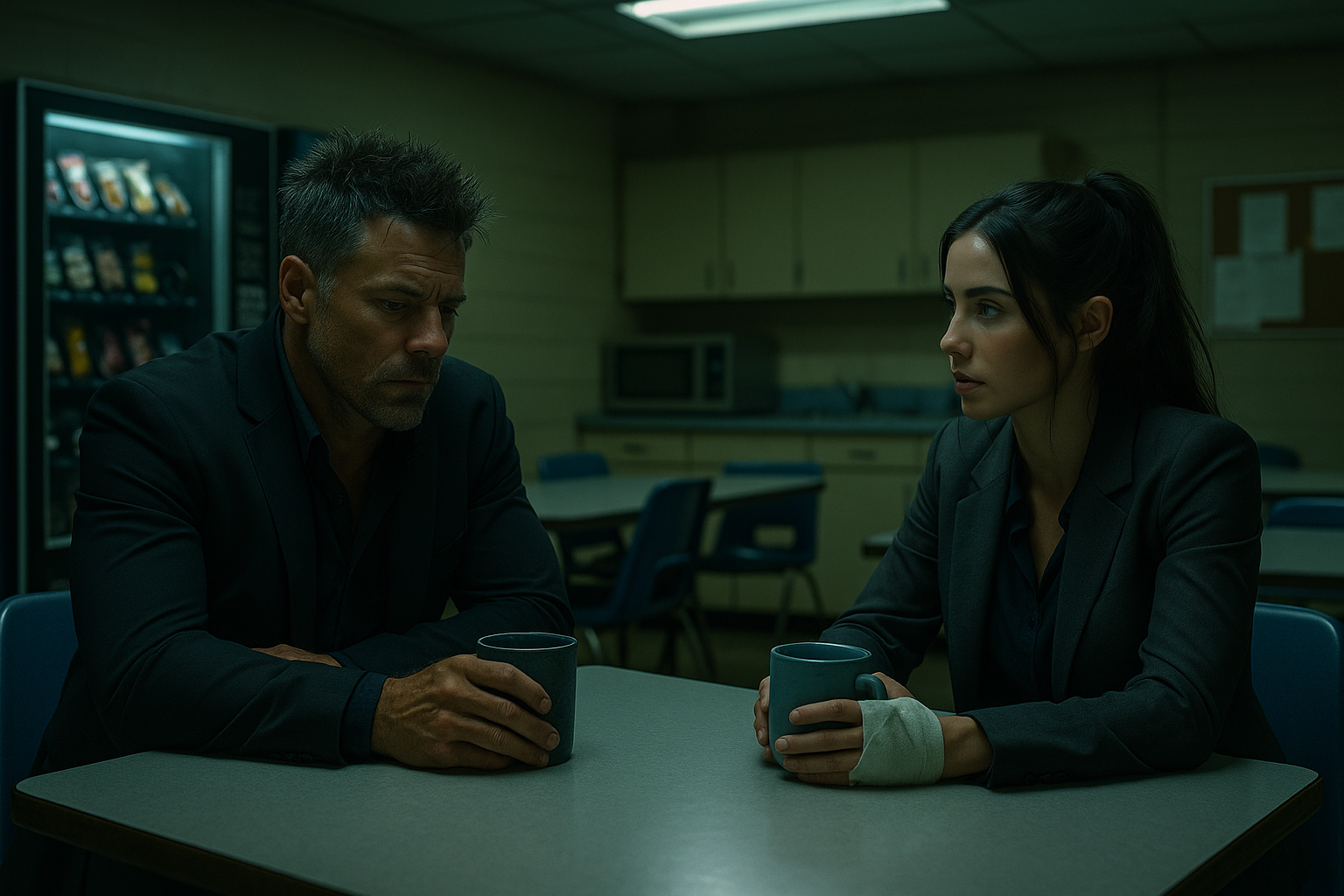
The station’s break room wasn’t much—just a corner kitchenette with a flickering fluorescent light that had been malfunctioning for weeks without anyone bothering to call maintenance, two vending machines that hadn’t been properly stocked in a while, their display windows showing gaps where popular items should have been, and a scatter of tables and chairs that didn’t quite match, assembled from various decades of institutional purchasing decisions.
But it served a purpose. Neutral ground, away from the eyes and ears of the bullpen, away from the hierarchies and politics that governed the rest of the building.
I sat alone at the far table, the one positioned in the corner where I had some control over sight lines, where I could see who was entering without being immediately visible from the doorway. Old habits from years of tactical awareness, positioning myself defensively even in supposedly safe spaces.
I was nursing a coffee that had long since gone cold, its surface shimmering faintly with an oily sheen that spoke of cheap beans and inadequate filtering. The liquid had been undrinkable when hot—now, at room temperature, it was actively unpleasant, bitter with a chemical aftertaste that coated my tongue. But I kept it in front of me anyway, something to occupy my hands, to give me something to focus on besides the spiralling thoughts.
Around me, the low hum of conversation and the occasional metallic snap of a microwave door made up the room’s muted rhythm. The familiar sounds of morning tea at any police station: officers grabbing quick snacks between shifts, the constant background noise of an institution that never quite stopped functioning.
Someone’s spoon scraped too hard across a bowl, the sound like fingernails on slate. Another voice laughed too loudly, too bright—the forced cheer of someone trying to maintain normality through sheer vocal volume.
Everything grated. Every sound felt amplified, every sensation too sharp, too present. The exhaustion and excess caffeine had stripped away my sensory filters, leaving me raw and exposed to stimuli I’d normally process automatically.
I stared into the depths of the mug, watching the faint rainbow sheen shift across the black surface, trying to organise my thoughts into something resembling order. But they refused to cooperate, sliding away from rational arrangement into the same obsessive loops they’d been tracing since yesterday.
The idea that I might have hallucinated Luke’s voice gnawed at the edges of my sanity like a rat working at rope. It had been so clear, so undeniably present. Not ambiguous. Not something that could be misinterpreted or explained away as wind through broken glass or the house settling or any other rational explanation. The mocking tone had been unmistakable. The timing perfect. The message personal, specific, directed at me.
Two words. Deliberate. Impossible to mistake for anything but what they were.
"Bye, Karl."
But if the voice had been real, if Luke had actually been in that room when I’d heard him, how had he vanished from a sealed space? Sarah had blocked the doorway—I’d shoved past her, yes, but she’d been there, would have seen anyone trying to leave. The window had already been shattered by my elbow, but it was too dangerous to escape easily without injury or sound. There was nowhere else to go—no other doors, no trapdoors or hidden passages. And yet—he’d gone. Vanished as thoroughly as if he’d never been there at all.
Unless he hadn’t been there. Unless my mind, pushed beyond its limits by exhaustion, had manufactured the voice. Created an auditory hallucination so convincing that I’d acted on it with absolute certainty, had assaulted my partner in response to a threat that existed only in my deteriorating consciousness.
The thought was terrifying. Not just because it suggested I was experiencing psychotic symptoms, but because it meant I couldn’t trust my own perceptions anymore. Couldn’t distinguish between reality and delusion with any confidence. How could I function as a detective—how could I function as a human being—if I couldn’t rely on my senses to accurately report the world?
I rubbed my temples, fingers pressing against bone, trying to ease the headache that had taken up permanent residence behind my eyes. The pain was a constant presence now, throbbing with each heartbeat. Sleep deprivation was closing in like a fog, thoughts becoming sticky and repetitive, looping back on themselves without resolution.
I needed rest. Desperately. My body was screaming for it, muscles aching, eyes burning, coordination beginning to deteriorate in ways that would become dangerous if allowed to continue.
But rest would cost me time. Hours spent unconscious were hours not investigating, not following leads, not making progress on the cases that had consumed me. And Claiborne’s ultimatum left no room for such luxury. One week. Seven days. Already depleting with each passing hour.
One chance to prove I wasn’t delusional, to justify the mercy he’d extended, to find evidence that would vindicate everything I’d sacrificed.
"This seat taken?"
I blinked, startled to find Sarah standing there beside the table, materialising from my peripheral awareness where she’d approached unnoticed—a testament to how distracted I’d been, how compromised my situational awareness had become.
She held a mug of tea cupped in her uninjured hand. Steam rose from the surface in delicate wisps, carrying the faint scent of peppermint. Her other hand—the injured one—hung at her side, careful and protected.
She looked composed—too composed. That deliberate kind of calm that masked something darker underneath, the carefully constructed facade of someone who’d spent time preparing for this encounter, deciding what to say and how to say it. A white bandage wrapped around her left palm, fresh and stark against her skin.
Her hair was tied back in its usual no-nonsense ponytail, pulled away from her face with utilitarian efficiency. But a few loose strands had escaped the elastic, curling around her cheekbones in a way that softened her features, made her look younger, more vulnerable than the hardened detective persona she projected.
Shadows of fatigue clung to the delicate skin beneath her eyes, but she was beautiful in a way that twisted something inside me—a complicated knot of guilt and longing and regret that I didn’t have the energy to untangle.
"No, please." I gestured towards the empty chair, my pulse ticking up at her proximity. My throat felt dry, constricted, making speech difficult.
Our relationship had always defied neat categorisation, had resisted the simple labels that made professional interactions comprehensible. Partners first—that was clear enough, the formal designation that governed our working lives. Then occasional lovers when loneliness or stress or simple human need overcame professional boundaries. And lately… something more nebulous. A closeness neither of us had dared name or define, an emotional intimacy that existed alongside and separate from the physical connection.
Now, after yesterday, after I’d shoved her into a wall and caused injuries that required medical intervention, I didn’t know what we were. What I’d broken. Whether the damage was repairable or if I’d crossed a line that couldn’t be uncrossed, destroyed something irreplaceable through violence and poor judgement.
"Sarah, I—"
"Don’t." She sat before I could finish the apology that had been forming. "I’m not ready for apologies yet."
I nodded, accepting the boundary without protest, swallowing the words I’d prepared. "How’s your hand?"
The question was safer, more concrete. Focused on physical injury rather than emotional damage, on something that could be quantified and treated rather than the more complex hurt that existed beneath.
"Six stitches. Doctor says it’ll heal clean, no permanent damage." Her tone was clinical, almost sterile, the voice she used when reading reports or presenting evidence. Deliberately stripped of emotion. But her eyes—those warm, sharp eyes that had always been able to read me too well—held more. Hurt that went deeper than physical injury. Confusion about what had happened, about who I’d become in that moment. A thread of anger still taut beneath the surface composure, righteous and justified.
"The headache’s worse, to be honest."
Guilt flared hot again at the mention of her concussion, the reminder of brain trauma I’d caused. The hand would heal—stitches would come out, scar tissue would form, eventually she’d regain full function. But concussions were different, more unpredictable. The symptoms could linger for weeks or months, could cause persistent problems that affected her work and quality of life.
I couldn’t look at her directly, couldn’t meet her eyes whilst discussing injuries I’d inflicted. My gaze dropped to the table surface, tracking the pattern of scratches and stains accumulated over years. "I never meant to hurt you."
"But you did." The words were simple. Stark. Delivered without venom or theatrical emphasis. Just fact, stated plainly because facts needed acknowledging. "You lost control, Karl. You pushed me into a wall and then tore apart a room based on a voice that no one else heard."
Reduced to essentials, my actions sounded indefensible—violence based on a perception only I’d experienced.
I didn’t respond immediately. What could I say? The defences I’d rehearsed all morning—rooted in instinct, in the certainty of that moment, in years of reliable judgement—now rang hollow in the face of her quiet honesty. Her words left no room for rebuttal, no space for justification or explanation that wouldn’t sound like excuse-making.
A chair scraped somewhere behind me, and I fixed on the sound—on anything besides her face, her injuries, the disappointment in her expression.
I noticed the bruising at her temple for the first time—a faint discolouration just beneath her hairline, the kind of mark that comes from impacting solid surface. Another injury I’d caused, another mark I’d left. The sight of it made my stomach churn, acid rising in my throat.
How many times had I touched that jaw gently, affectionately? And now I’d marked her with violence.
Sarah exhaled slowly, deliberately, a sigh that seemed to lift some of the tension from her shoulders, allowing them to drop from the elevated position they’d been holding. She leaned forward, elbows on the table, voice pitched lower so it wouldn’t carry to the other officers scattered around the break room.
"I filed the incident report this morning. Early, with Claiborne. Kept it as minimal as possible. Fell during a search, caught my hand on broken glass. No mention of you pushing me or acting erratically. Nothing about voices or rubbish bags or any of it."
The confession surprised me, not because it was unexpected—I’d suspected as much from the way Claiborne had framed things—but because she was admitting it directly, acknowledging the choice she’d made.
She had protected me. Deliberately. After everything—after I’d physically assaulted her, after I’d put the case ahead of her safety, after I’d given her every reason to throw me to the disciplinary wolves—she’d drawn a professional line to contain my mistake, to keep me from facing formal consequences I probably deserved.
She’d lied in an official report to shield me from the full fallout of what I’d done.
"Claiborne helped," she added. "More than helped, actually. He was… surprisingly willing to make this go away. To frame it as simple workplace accident rather than—"
My throat tightened, something raw pushing up under the careful composure I’d been maintaining. "I don’t deserve that kind of loyalty."
"No, you don’t," she said immediately, honestly, unflinchingly. No false reassurance, no attempt to minimise my culpability. Just acknowledgement of objective truth.
But then, the barest flicker of something passed across her face—an expression I couldn’t quite read, complex and fleeting. The corner of her mouth twitched upward microscopically—almost a smile, almost not. "But we did it anyway."
The statement hung in the air between us, charged with implication. Why? The question filled the space she hadn’t explicitly addressed. Why would she protect someone who’d hurt her? What drove that loyalty despite everything?
"Thank you," I said quietly, the words feeling too small, too inadequate for what she’d done. But I meant them with an intensity that went beyond mere politeness. "Thank you."
More than she could know. More than I could articulate in this public space, surrounded by colleagues who couldn’t know the full context of what was passing between us.
Her eyes dropped to my wrist, where my shirt cuff had ridden up slightly during some unconscious gesture. A row of small, angry red cuts stood out starkly against the skin of my inner forearm—linear abrasions from broken glass, still fresh enough to be inflamed, not yet scabbed over completely.
"What happened there?"
The question was casual in tone but sharp in implication.
I froze, breath catching slightly. For a second, I couldn’t form a coherent answer, my exhausted brain struggling to construct a plausible explanation. Her question had reached straight through the haze and pulled me back with a jolt, forcing me to confront another piece of evidence I’d been trying to ignore.
"Glass, I think," I said, too quickly. The lie stumbled out, clumsy and rushed, the words emerging with insufficient preparation. "Must have got them from the same broken glass as you, when I was…" I trailed off, unable to complete the sentence. The rest died in my throat, choked by the vivid memory of my frenzied, futile search through those rubbish bags.
The explanation was technically plausible—there had been broken glass in that room, from the window I’d shattered. But the cuts on my wrist weren’t from searching the room. They were from breaking the window in the first place, from driving my elbow through glass in a moment of desperate frustration.
"When you were ripping apart rubbish bags looking for a man who wasn’t there?"
The completion of my unfinished sentence should have felt like accusation, like mockery. But there was no judgement in her tone. No attempt to shame or diminish. Just calm, unadorned concern. The voice of someone genuinely worried about another person’s wellbeing rather than scoring points or proving superiority.
And somehow, that made it worse. I could have defended myself against accusation, could have marshalled arguments and justifications. Against her concern, I had nothing.
Her voice was soft when she continued, but the words landed like quiet thunder, reverberating in ways that loud volume never could. "What’s happening to you, Karl? This obsession with the Greyson and Jeffries case, the outbursts… it’s not like you."
The assessment was accurate and impossible to refute. This wasn’t like me—at least not like the me I’d been for most of my career. Controlled. Methodical. Professional. That version of Karl Jenkins wouldn’t have broken into a house, wouldn’t have assaulted a partner, wouldn’t have prioritised intuition over evidence.
"I know there’s more to it," I said, barely above a whisper, the words emerging with the quiet intensity of absolute conviction. "Jamie, Kain—they’re tied up in something bigger. And Luke’s at the centre of it. I can feel it."
Even as I said it, I recognised how it sounded. I can feel it—the last refuge of someone whose evidence had run out, who was relying on intuition because facts wouldn’t support the narrative they’d constructed.
"Feel it?" She raised one eyebrow, the expression not quite mocking but definitely incredulous. "Since when do you rely on feelings instead of evidence?"
The question struck at the heart of my professional identity. I’d built my career on evidence, on methodical investigation, on building cases that could withstand judicial scrutiny. Feelings were what civilians relied on. Detectives dealt in facts.
"The evidence is there," I insisted, though even to my own ears it sounded thin, defensive. "It’s just… elusive."
She didn’t reply immediately. Her fingers tightened around her teacup, a subtle movement that betrayed more than her composed expression allowed, the ceramic creaking under the pressure. I watched her hand flex, noted the careful way she held the injured one, felt the absence of it in mine.
There was a time, not that long ago, when she might have reached across the table without thinking, when physical contact between us had been natural and frequent. Her hand on my arm for emphasis. My hand on her shoulder in reassurance. The unconscious touches that partners develop over time, that communicate support and connection beyond words.
Now, the distance between us felt deliberate. Willed. A boundary she was actively maintaining, space she needed that I’d violated through violence.
"What did Claiborne say?" she asked eventually, shifting the focus with quiet tact, redirecting away from the case to safer ground. "I expected him to take your badge, at least temporarily."
"He gave me a week," I said, still not quite believing it myself, the reprieve feeling surreal even hours later. "One week to find something concrete before he reassesses."
A flicker of surprise passed across her face, eyebrows rising slightly, composure cracking to reveal genuine shock. "He’s keeping you on the case? After what happened?"
"Against all protocol and his better judgement, yes."
"Claiborne never breaks protocol," she murmured, more to herself than to me, thinking aloud. Her brow furrowed, confusion evident. "Never."
"I know. I can’t figure out why he’s making an exception now."
The mystery of it gnawed at me, another unanswered question in a case full of them. What had prompted Charlie Claiborne, the most by-the-book supervisor I’d ever worked under, to bend the rules for the man who’d just trampled all over them?
"Maybe he sees something in this case too," she said thoughtfully, then hesitated, considering alternative explanations. "Or maybe he just doesn’t want to lose his best detective over one mistake."
The compliment caught me off guard—unexpected in this context, undeserved given my recent behaviour. My best detective. After everything I’d done, she still saw me that way. Or was willing to voice it, at least.
"We both know I’m not his best detective."
The protest emerged automatically, deflecting praise I couldn’t accept, unable to reconcile the compliment with the reality of my recent failures.
"No?" Her eyes lifted to mine then, direct and unflinching, holding contact in a way they hadn’t since she’d sat down. The first time she’d truly looked at me rather than past me or around me. "Your clearance rate says otherwise."
But statistics felt meaningless in the face of assault and possible hallucination.
A silence bloomed between us, expanding to fill the space around the table. Not cold—there was too much history for that, too many shared experiences and confidences. Not hostile—her presence here, willingly sitting with me despite everything, precluded hostility.
The kind of silence that says more than words ever could, that communicates through absence and presence simultaneously.
Around us, the break room’s normal life continued: chairs scraping across tile as people left and arrived, phones chiming faintly from pockets and bags, teaspoons clinking against ceramic mugs. But all of it seemed distant, muffled, as though we existed in a bubble slightly removed from the ordinary world, in a space where only the two of us and the unspoken thing between us truly existed.
The nights we’d shared. The closeness we’d developed. The blurred line between partners and something else, between professional and personal, between what we were and what we might become.
It all hung in the space between the table and our hands that never quite reached for each other, suspended in possibility and uncertainty.
After yesterday, none of it made sense anymore. The violence had disrupted the careful equilibrium we’d been maintaining, had thrown everything into chaos and left me unsure what survived.
And all of it mattered more than ever, because losing it—losing her—would be worse than losing the badge, worse than any professional consequence.
"Are we okay?" I asked finally, the question heavier than it sounded. It wasn’t just about whether we could function as partners. It was wrapped in every late-night look, every quiet comfort we’d shared off duty—everything I’d been too cautious or too cowardly to name.
Are we okay? meant Can you forgive me? Can we recover from this? Is there still an us to salvage?
Sarah didn’t answer straight away. She traced the rim of her teacup with her uninjured hand, her gaze fixed on the movement, as though the repetitive motion held the answer or at least provided thinking space. I watched her fingers circle the porcelain—calm, controlled, utterly unlike the chaos I’d brought crashing down between us.
The silence stretched, became uncomfortable, made me want to retract the question or fill the space with additional words. But I forced myself to wait, to let her process and respond in her own time.
"I don’t know," she said eventually, her voice quiet but steady, not avoiding the question but answering honestly. "What happened yesterday… it scared me, Karl. Not just that you hurt me—accidents happen in our line of work. We’ve both been injured before. But the look in your eyes…"
She paused, searching for words, trying to articulate something difficult.
"It was like you weren’t even there. Like you’d gone somewhere else entirely and left just… rage behind. Disconnected from everything around you."
The description hit hard, sharper than any direct rebuke. Deeper than anger or disappointment. It wasn’t violence she’d seen in me—it was absence. Disconnection. I’d lost sight of her, of the situation, of myself. Had become someone she didn’t recognise.
"I’m still me," I said softly, reaching across the table with deliberate slowness, my fingers brushing hers in a light, tentative touch. Testing whether contact was still allowed, whether that boundary remained open.
She didn’t pull away immediately. Didn’t flinch or recoil. Just let the contact exist for a moment before her hand stilled beneath mine. That felt like something—not acceptance exactly, not forgiveness, but not rejection either. A small, wavering signal that the door hadn’t shut completely, that connection remained possible even if damaged.
"Are you?" she asked, and the question wasn’t rhetorical, wasn’t accusatory. It was genuine uncertainty, real doubt about whether the man she’d known still existed underneath it all. "Because the Karl Jenkins I know—the man I…"
She stopped herself mid-sentence, words trailing off into significant silence. Drew back slightly, both physically and emotionally, retreating from whatever she’d been about to say. Her hand slipped away from mine, breaking the contact.
"The Karl Jenkins I’ve been partners with wouldn’t lose control like that."
Her voice was calm, carefully measured. But the unfinished sentence rippled in the air between us like a wire pulled too tight, vibrating with unspoken meaning. The man I what? The man I’ve been sleeping with? The man I’ve started to trust beyond professional necessity? The man I might—?
The possibilities hung there, unvoiced but present. And I didn’t ask for clarification. Couldn’t. The conversation was already too heavy, too fraught. Pushing for definition of something we’d deliberately left undefined felt like it would shatter whatever fragile understanding we’d maintained.
"You should go home," Sarah said, shifting tone with quiet finality, closing off the personal and returning to practical concern. "Get some sleep. You look terrible."
The blunt assessment would have been funny in other circumstances. Classic Sarah—direct to the point of rudeness, calling things as she saw them without diplomatic cushioning.
A tired smile tugged at my lips despite everything, the expression feeling foreign after days of nothing but tension and dread. I welcomed it like the sun breaking through low clouds, a moment of normality in the ruins of everything else. "Always the charmer, Lahey."
"Always the truth-teller, Jenkins." The ghost of our old rhythm flickered back to life, just for a second. The familiar pattern of teasing insult and counter-insult that had characterised our partnership from the beginning. Fleeting, but enough to remind us both that something of what we’d been still existed beneath the damage.
She rose from the table, collecting her mug with careful movements, mindful of the injured hand. The bandage on her palm tugged at my conscience all over again, a visible reminder of damage done, of trust violated, of the moment everything had gone wrong.
"I’ll see you this afternoon. Two o’clock, my desk. We need to review everything we have if we’re going to make any progress in the next week."
The pressure that had been sitting on my chest since I’d entered the break room eased fractionally, just enough to allow deeper breath. She’d said we. Not "you need to review" or "I’ll work on this separately"—but we. She was still in it, still willing to work the case alongside me. Still my partner, at least professionally, despite everything I’d done.
"I’ll be there."
Sarah nodded, accepting the commitment at face value, then turned as if to go. But she hesitated at the last moment, pausing with her hand on the back of the chair, body angled towards departure but attention returning to me.
"Karl," she said, her voice softer now, stripped of professional detachment. No longer detective to detective, but person to person, human to human. "Be careful. Whatever’s happening with this case… it’s changing you. And I—"
She paused, long enough for something to rise in her expression, some emotion breaking through the careful composure. Not quite fear, not quite anger. Something more complex, mixing concern with something that might have been grief for what was being lost.
"I’d like the old Karl back."
The words hit harder than anything Claiborne had said, harder than any formal reprimand or threat of suspension. They struck at something essential, at identity and self-conception and the fundamental question of who I was beneath the badge and the case.
That we—the almost, the maybe, the fragile thing we hadn’t dared define—it was still there. Just barely. Hanging by the thinnest of threads. But for how long? How much more damage could it survive before breaking completely?
"He’s still here," I promised, wanting desperately for it to be true, needing to believe that I hadn’t fundamentally altered into someone unrecognisable. "Just a bit lost at the moment."
Lost in the labyrinth of this case, lost in exhaustion and doubt, lost in the territory between detective and something darker. But still present somewhere, still recoverable if I could find my way back.
Something softened in her face at the response—a micro-expression, barely perceptible but definitely present. Just enough to tell me the promise mattered, that she wanted to believe it even if she wasn’t entirely sure she could.
"Find your way back, then."
And with that, she turned and walked away, her steps steady despite the injury, maintaining the composed professionalism she’d shown throughout. But I saw the faint wince as she moved—residual pain from the concussion, the headache she’d mentioned earlier manifesting in physical discomfort. A mark I’d left, another consequence of my violence that would take time to heal.
I remained seated for a moment longer, fingers curled loosely around the empty coffee mug that had gone from cold to room temperature, the ceramic warming slightly in my grip. The chair across from me still held her residual heat, her absence as present as her company had been, the negative space she’d occupied somehow more significant than the positive space I inhabited.
There was more at stake here than just the case, more than Jamie Greyson’s disappearance or Kain Jeffries’ fate or even Luke Smith’s involvement. I’d known it in theory, had been peripherally aware of the personal costs of all this. Now I felt it in my chest, visceral and undeniable—the knowledge that I was destroying something precious, something that couldn’t be recovered once fully broken.
If I lost this—if I lost Sarah—I wouldn’t be able to blame it on the job, on Luke, on circumstances beyond my control. I’d only have myself to blame. My choices. My choice to put the chase ahead of the people who mattered. My willingness to sacrifice everything for a truth that might not even exist.
Seven days to prove I wasn’t losing my grip on reality, and to begin undoing the damage—to trust, to partnership, to whatever fragile thing still existed between us. If it could be undone at all.
I downed the last mouthful of cold coffee, grimaced at the bitterness of it, and rose from the chair. My body protested immediately, muscles aching with accumulated fatigue, joints stiff from prolonged sitting and inadequate rest. But I ignored it, pushed past the physical discomfort through sheer force of will.
Sleep could wait. Should wait. Needed to wait, despite Sarah’s advice and my body’s demands. There were too many hours already lost, too much ground to make up.
There were leads I hadn’t followed, threads I’d overlooked whilst fixated on Luke. Nial Triffett’s disappearance, for instance—I’d taken Jenny’s statement but hadn’t properly integrated it into the larger pattern. Phone records to analyse. The mysterious delivery truck to trace. Connections to map.
I needed to work—not just to find Luke, but to find myself again. To prove I could still function as a detective, could still follow evidence methodically, could still separate speculation from fact.
As I stepped into the corridor, leaving the break room’s neutral space behind, the ordinary clamour of the station closed around me again.
But beneath it, I felt something shift inside me. Not dramatically. Not obviously. Just a subtle recalibration of internal state.
Not clarity—that was too strong a word for what I felt. Not yet. I was still confused, still exhausted, still uncertain about what was real and what was delusion.
But direction. A sense of path forward, of next steps, of how to use the limited time Claiborne had given me.
And for now, that would have to be enough.
