Blackwood, South Australia
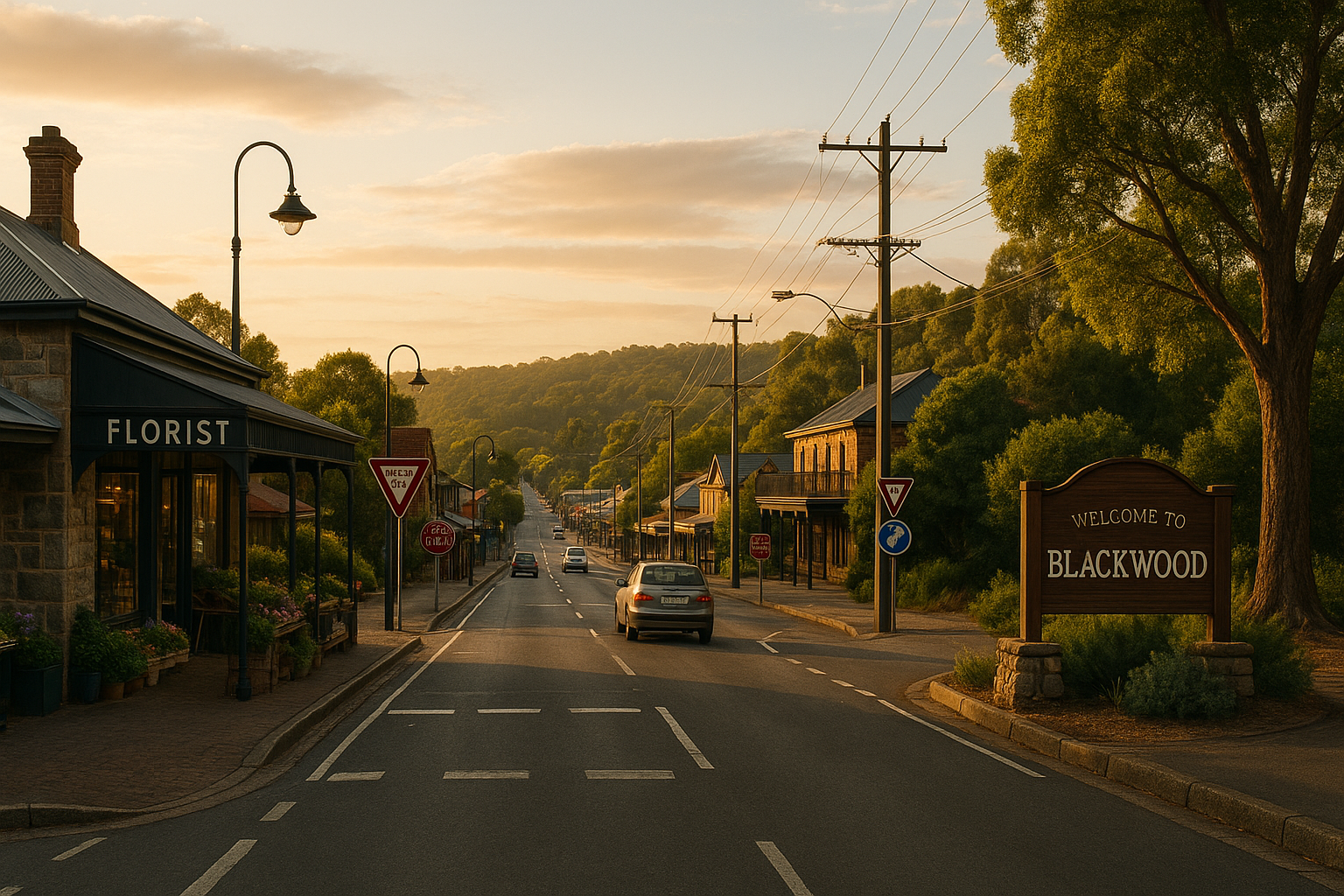
Blackwood grew from a scatter of huts around a shanty inn on Kaurna Country into one of Adelaide's best-known hills suburbs, thirteen kilometres south of the city in the City of Mitcham. The railway's arrival in 1883 turned orchards and timber country into a commuter settlement, and post-war subdivision filled its slopes with family homes. Bushland, gullies and Belair National Park defined its character, while Blackwood Primary School anchored community life for more than a century.
Kaurna Country and Early Land Grants
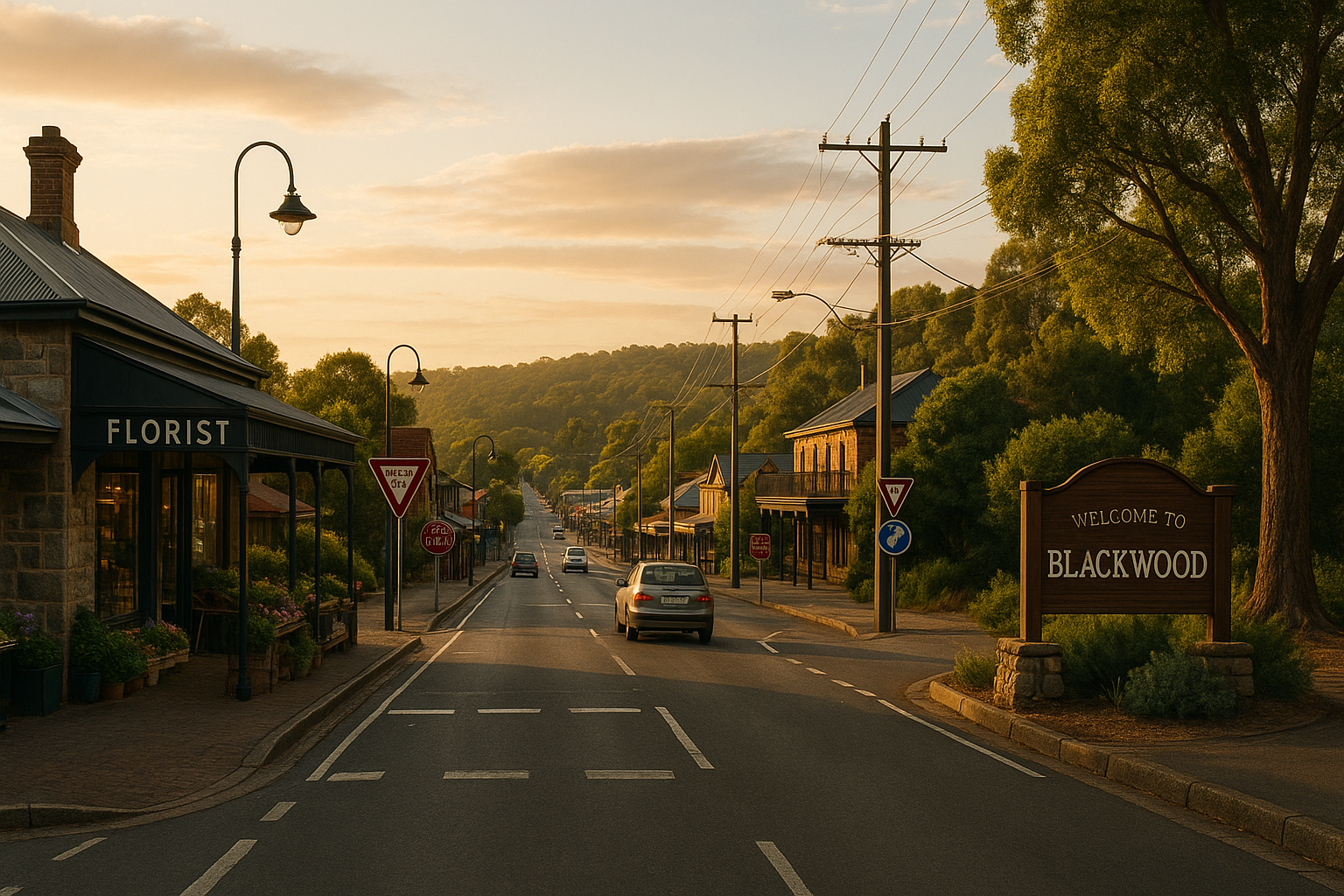
The ridges and gullies that became Blackwood lay within the traditional Country of the Kaurna people, whose seasonal movement between the Adelaide Plains and the hills followed the watercourses that cut down from the Mount Lofty Ranges. The creeks, the open grassy woodland of the lower slopes and the denser stringybark forest above them were all part of a landscape the Kaurna had managed with fire and knowledge for thousands of years before European arrival.
Following the colonisation of South Australia in 1836, surveyors pushed into the foothills south of Adelaide in search of timber, water and land fit for cultivation. The first land grants in the Blackwood area were issued in 1840. For the next four decades the district remained thinly settled: timber cutters worked the stringybark and red gum on the higher ground, a handful of small farmers cleared the gully floors for vegetables and fruit, and the bullock tracks that wound up from Mitcham towards the Belair hills were rough enough to discourage all but the determined.
The Blackwood Inn and the Naming of the District
Before 1880 the settlement consisted of a few huts and a small wooden shanty hotel kept by Josiah Hambly, a Cornish-born former miner from Burra whose name the district rate books managed to spell three different ways. The hotel traded as the Blackwood Inn, and it was the earliest recorded use of the name. Hambly's trade came mostly from timber cutters and bullock drivers resting their teams before the final climb, and the inn kept a reputation for rough company and cheap rum that respectable households in Mitcham did not let him forget.
The origin of the name itself was never settled with certainty. It came either from the Australian blackwood, Acacia melanoxylon, which grew in small clumps through the Mount Lofty Ranges, or from the peppermint box, Eucalyptus odorata, which grew locally and carried a distinctly dark bark.
The district's postal history reflected its shifting identity. A Belair Post Office had opened in 1859 to serve the scattered hills households. When the Belair office was moved some distance away in 1881, the original post office was renamed Blackwood. The inn followed the opposite path, taking the name Belair Hotel in 1880, so that for a time the two names were attached to the same patch of hillside in reverse.
The Railway and the First Subdivisions
Blackwood's transformation began with the railway. Land was first subdivided for housing in 1879 in anticipation of the line, and a Methodist church was built in 1881 for the small congregation that had gathered in the district. In 1883 the railway from Adelaide up into the hills opened, and Blackwood station opened with it, eighteen kilometres by rail from the city. Coromandel station, a short distance down the line, opened the same year. The railway was later carried all the way through to Melbourne, and the trains that laboured up through the cuttings and tunnels below Blackwood became the district's lifeline.
The effect was immediate. A journey into the city that had taken half a day by cart now took less than an hour. Public servants, clerks and tradesmen bought blocks within walking distance of the station, and Adelaide families began taking summer cottages in the hills to escape the heat of the plains.
Guesthouses followed. The best known was Glenburn House, a two-storey stone residence above the station run from 1891 by Mrs Clara Pengelly, the widow of a Burra copper captain, who advertised its "pure hill air, garden walks and a table supplied from our own orchard" in the Adelaide papers each November. For three decades Glenburn took in city families for the summer months, convalescents sent up by their doctors, and honeymooning couples who could not afford Victor Harbor. By the turn of the century Blackwood had become a recognisable village, with a cluster of shops near the station, churches of several denominations and a growing number of permanent residents.
The Blackwood Institute, established in 1906 through community subscription, gave the village its first public hall. It served as a meeting place, lending library and venue for dances and amateur theatricals, and it remained the centre of Blackwood's civic life well into the 1970s.
Orchards and the Fruit Trade
The fruit trade sustained Blackwood's economy through the early twentieth century. Orchards of apples, pears, cherries and stone fruit covered the gully slopes, and packing sheds operated near the station to ship produce to the Adelaide markets. The largest belonged to the Treloar family, Cornish-descended growers who worked forty acres along the creek below Shepherds Hill Road and packed for half a dozen smaller neighbours besides their own trees. In the picking season the Treloar shed ran from dawn until the evening train, staffed by family, schoolchildren on their holidays and itinerant pickers who slept in the loft.
The growers organised themselves in 1919 as the Blackwood Fruitgrowers' Co-operative, and its cool stores opened in 1921, allowing members to hold fruit for better prices rather than sell at the height of the season. For the next thirty years the co-operative was the most important economic institution in the district, and its annual meeting at the Institute was as well attended as any election.
War and the Interwar Township
The First World War drew young men from the orchards and the railway households. Forty-three men from Blackwood and its surrounding gullies enlisted; eleven did not return. They were commemorated after the war by the Blackwood Soldiers' Memorial, which became the focus of the district's Anzac Day observances. In 1916, while the war was still being fought, residents won the Education Department's approval for a school of their own, and Blackwood School opened on Shepherds Hill Road in March 1917 with thirty-two pupils.
The interwar years brought steady civic organisation. Miss Alice Meredew, a former schoolmistress who became the district's most capable organiser of local services, was instrumental in founding the Blackwood Women's Association in 1929. Her handwritten minutes of its meetings, later deposited with the Mitcham Library, recorded the township's concerns through the Depression: relief work for unemployed men, clothing drives for struggling families, and the long campaign for better roads. Several orchard families lost their holdings to the banks in those years, and the co-operative survived only by selling one of its two cool rooms. The new Blackwood Masonic Lodge building was opened in March 1934 by the Mayor of Mitcham, Councillor Arthur Pryce, himself a Blackwood orchardist and a member of the lodge for thirty years.
The hills also drew writers and artists. Harold T. Layne, a regional poet who published regularly in The Advertiser, walked the gullies between Blackwood and Upper Sturt and drew on them for his small anthology Gully Days, published in 1937. Glenburn House, past its prime as a guesthouse, became for a time a lodging for painters who came up from the city on weekends to work en plein air along the creek.
In 1928 the railway was duplicated from Eden Hills, and Blackwood station served for a time as the terminus of the double-track section, confirming the village's place as the gateway to the southern hills.
The Second World War took a second generation of Blackwood men overseas and turned the Women's Association into a wartime organisation. Its members knitted for the Comforts Fund, ran a Red Cross depot from the Institute, and organised the collection of scrap metal and fruit for the troops. The Treloar shed packed tinned fruit for the army under contract from 1942.
The Post-War Suburb
The suburban boom that followed the war changed Blackwood more than any period since the railway. Orchards were subdivided into housing allotments, and cream-brick bungalows spread across slopes that had carried fruit trees a few years earlier. The Treloars sold the last of their land in 1959, and the co-operative wound up two years later. Young families arrived from the city, from interstate and from Britain and the Netherlands under the post-war migration schemes. Shepherds Hill Road and Coromandel Parade were sealed and widened as they became the suburb's main thoroughfares, and in 1958 a roundabout was built at the Five Ways intersection, which became the defining landmark of the suburb's centre.
The newcomers reshaped Blackwood's community life. The Blackwood Football Club, revived after the war, drew its players from the new streets and its supporters from every household within earshot of the oval. A bowling club, a tennis club and a Scout troop followed. The migrant families brought their own customs: a Dutch bakery opened on Main Road in 1956, and the English households of the 1960s gave the suburb a reputation, still remarked on decades later, as one of the most English corners of Adelaide.
Despite its growth, Blackwood kept much of its semi-rural character. Unsealed laneways survived in the older streets, houses backed onto creek reserves and patches of uncleared bush, and native wildlife moved freely through the gardens. The services of a modern suburb followed: shops along Main Road, kindergartens and an expanded primary school. W.J. Haig & Sons Hardware, founded on Main Road in 1921 by William James Haig to supply the orchards with tools and packing timber, made the transition with the suburb and began selling to home builders and weekend gardeners instead.
Education
Blackwood Primary School grew with the suburb. Its single-room timber schoolhouse was joined by a red-brick classroom wing and assembly hall in 1957 under Headmaster Bernard Kilvington, and enrolment passed three hundred by 1964. The school's regular excursions to Belair National Park, begun in the late 1950s, became one of the shared experiences of a Blackwood childhood.
Under Principal Lenora Farquhar from 1979, the school adopted an integrated learning programme that drew families from beyond its immediate streets, including the Jenkins family of nearby Panorama, whose children Karl and Jessica attended through the 1980s. Their mother, Elizabeth Jenkins (née Thompson), succeeded Farquhar as principal in 1988 and led the school until 2005, the longest principalship in its history. Her tenure brought restorative behaviour policies, community partnerships for families in hardship, peer mentoring and the school's first computer room, and it established Blackwood Primary's reputation as one of the strongest primary schools in the southern foothills.
The Late Twentieth Century
The Blackwood Institute declined through the 1970s as television, the car and the new sporting clubs drew people away from its dances and lending library. Its committee closed the hall in 1979, and the building was sold and converted into a furniture restorer's workshop.
Its civic role passed to newer facilities. The Blackwood Recreation Centre opened in 1983, providing courts and halls for netball, martial arts and community theatre. The Blackwood Library opened in 1987 near Wittunga Botanic Garden and quickly became one of the busiest branches in the City of Mitcham. Wittunga itself, a former private garden on Shepherds Hill Road laid out over forty years by the naturalist Frederick Calloway and given to the state by his daughter after his death, became one of the suburb's best-loved green spaces, with its lake, native plantings and South African and Australian collections drawing visitors from across Adelaide.
The Ash Wednesday fires of February 1983 did not reach Blackwood, but they came close enough to leave a lasting mark. Smoke from the fires in the higher hills darkened the suburb through the afternoon and evening, ash fell on Main Road, and the Blackwood Country Fire Service brigade, under its captain Ron Mitchinson, was sent up to the fire grounds near Stirling and Mount Lofty. The assembly hall at Blackwood Primary School was opened overnight as a relief centre for families evacuated from the hills above. For many residents it was the night the danger of their landscape stopped being theoretical, and membership of the local brigade doubled within the year.
Environmental awareness grew alongside the suburb's sense of its own character. The Friends of Blackwood Creek was established in 1992 by Milton Cleave, a retired teacher who organised volunteers to remove weeds, replant native species along the creek line and repair the erosion caused by decades of stormwater runoff from the streets above. The group became the model for several similar creek and reserve groups across the foothills.
Landscape and Environment
Blackwood's identity was always bound to its landscape. The suburb occupied a ridgeline and a series of valleys at the southern edge of the Adelaide Hills, its elevation giving it cooler summers and wetter winters than the plains below. Belair National Park lay to the north-east, Sturt Gorge Recreation Park to the south-west, and green corridors of creek reserve and remnant bush threaded between the residential streets.
Stringybark, blue gum, sheoak and native orchids survived in the reserves and larger gardens. Koalas were regularly seen in residential trees, blue-tongue lizards sunned themselves on driveways, and sulphur-crested cockatoos and other parrots moved through the suburb in loud seasonal flocks. Many residents treated their backyards as extensions of the surrounding conservation land, and planting native species became a point of local pride.
The same landscape brought risk. Blackwood's position among dense bushland on steep slopes placed it within the Adelaide Hills bushfire zone, and summer fire danger became a fixed part of local life, shaping building regulations, garden practice and the planning of every hot season.
Blackwood in the Twenty-First Century
By the 2020s Blackwood had become one of Adelaide's most established hills suburbs, home to a little over four thousand people, an older population than most of the city, and a high proportion of residents born in England. The suburb retained a village feel despite its place within the metropolitan area, with its commercial precinct concentrated along Main Road and around the Five Ways roundabout. Bakeries, bookshops, cafés and long-standing family businesses traded there, among them Haig & Sons, by then in the hands of the fourth generation of the family.
The Belair railway line continued to carry commuters into the city from Blackwood and Coromandel stations, supplemented by bus services through the hills. Blackwood's housing reflected each stage of its growth: Federation cottages near the station, cream-brick bungalows of the 1950s, split-level homes of the 1970s cut into the slopes, and newer energy-efficient houses on subdivided blocks. Glenburn House, restored in the 1990s, survived as a private residence above the station.
Blackwood Primary School passed five hundred students in the early 2020s, drawing from Blackwood, Coromandel Valley and Eden Hills. The community calendar was marked by the Blackwood Autumn Fair, Carols in the Park at Christmas and bushwalks during National Reconciliation Week, events that reflected the values the suburb held in common: care for its heritage, for its children's education and for the bushland that had shaped it from the beginning.