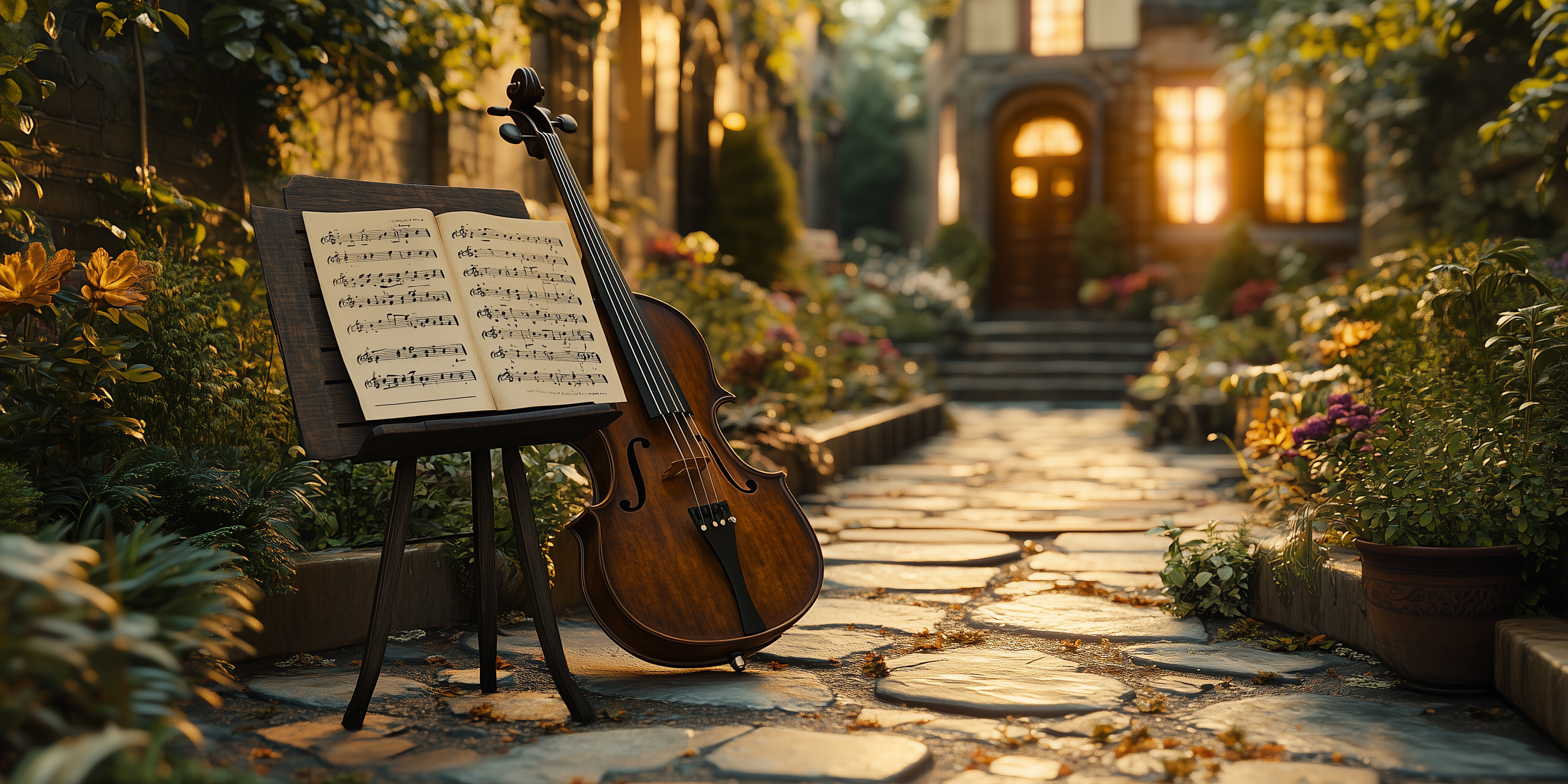
Amelia Margaret Harrington (née Rothschild)
Amelia Margaret Harrington née Rothschild was born in Hobart on 15 March 1983, the eldest child of historian Richard Rothschild and botanical artist Margaret Wainwright. A violinist turned violist, she trained at the Hobart Conservatorium and the Royal Academy of Music before joining the Tasmanian Symphony Orchestra in 2008, becoming principal viola in 2019. She co-founded The Tasman Strings quartet, married landscape architect Nate Harrington in 2012 and has one daughter, Elowen.

The Eldest
Amelia Margaret Rothschild was born on 15 March 1983 at the Royal Hobart Hospital, the first child of Richard Alan Rothschild, a history teacher at St Michael's Collegiate School, and Margaret Elizabeth Rothschild née Wainwright, an English-born art teacher and botanical painter. Her parents were living in a rented flat in Battery Point, and she spent her first year in a cot beside the kitchen table where her father marked essays and her mother painted in the evenings.
In 1984 the family moved to an old Victorian house in upper Sandy Bay with high ceilings, unreliable plumbing and a large, neglected garden. Her brother, Samuel Edward Rothschild, was born in 1985 and her sister, Clara Anne Rothschild, in 1987. The same year her brother was born, her mother gave up teaching to paint full time, and for most of Amelia's childhood the household ran on a single teacher's salary, private tutoring and whatever commissions Margaret could find. The house was never short of books, paint or argument. It was often short of money, and the children knew it.
Amelia was a serious, watchful child who disliked being looked at and liked to listen. She would sit under the piano at her grandmother's house in Sandy Bay while her aunts and uncles talked, and she could hum back the tunes from her father's records before she could read. Her father thought she would be a historian. Her mother, who saw her sit for an hour in the garden listening to wattlebirds, was less sure.
Geraldine Whitford's Front Room
She began violin lessons in 1990, at seven, with Geraldine Whitford, a retired violist of the Tasmanian Symphony Orchestra who taught from the front room of her house in Mount Stuart and charged the Rothschilds less than she charged most families. Miss Whitford was strict, unsentimental and seventy, and she told Margaret after the first month that the girl had an ear and a temper and that both would be useful.
The same year Amelia started at St Mary's College, the Catholic girls' school in central Hobart. The choice was her grandmother's. Helena Rothschild, who had never quite forgiven her son for leaving the Church or for marrying outside it, offered to help with the fees, and Richard, who could not afford to refuse, accepted on the understanding that nobody would mind if Amelia did not believe any of it. She went to Mass with the school and with her grandmother, sang in the choir, and kept her own counsel. The arrangement suited everyone better than it should have, and it was the beginning of a real closeness between Amelia and Helena.
Margaret drove her to lessons, rehearsals, eisteddfods and youth orchestra camps for the next fifteen years, in a succession of second-hand cars that broke down on the Southern Outlet more than once. Amelia practised before school and after it, in the cold back bedroom at Sandy Bay, and was not always pleasant to live with. Samuel complained about the noise. Clara, who idolised her, sat on the end of the bed and drew her.
The Lower Voice
The winter of 1995 and the year that followed were the hardest of her childhood. Her father had been unwell for some time, in a way the children did not have words for, and in March 1995 his younger sister Rebecca died suddenly of a brain aneurysm at thirty-six. Richard sank into a depression he could no longer hide and took a term's leave from Hobart College in 1996. Margaret kept painting because the commissions paid the mortgage, and Amelia, at thirteen, took on more of the care of Samuel and Clara than any child should have had to.
She made their lunches, walked Clara to school, sat with Samuel over his homework and practised late into the evening when the house was quiet. Years afterwards she said that she grew up a good deal that year, and that she had not entirely forgiven anyone for it, herself included. It was also the year she began to have what she later recognised as panic attacks before performances: a tightness in the chest, cold hands, and the certainty that she would stop in the middle of a phrase. She told no one.
In 1996 Miss Whitford put a viola in her hands for the first time and told her to play the opening of the Brahms sonata. Amelia, who had been struggling with the brightness of the violin, found in the darker, lower instrument something that suited her. She switched for good the following year. Miss Whitford, who had played the viola for thirty years in the orchestra's back desks, said it was the only time she had ever converted a violinist and did not intend to try again.
The Conservatorium
Amelia finished at St Mary's in 2000 with strong marks in English, history and music, and entered the Hobart Conservatorium of Music in 2001 to study viola performance. She lived at home, worked weekend shifts in a café in Salamanca Place and took the bus to classes. Her teacher there, Professor Charles Lindemann, was a German-trained violist who had come to Tasmania late in his career and who was the first person to tell her that she played as though she were apologising.
She completed her Bachelor of Music in 2004 and an honours year in 2005, with a recital programme built around the viola sonatas of Rebecca Clarke and Hindemith. She won the Conservatorium's prize for performance in her final year. The panic before concerts did not go away, but she learned to manage it with routine: the same breakfast, the same walk, the same hour of silence before she went on.
In 2006 she won a place at the Royal Academy of Music in London to study for a Master of Music under Dr Hermione Blake. Her parents could not afford it. The fees and the cost of living in London were met by a scholarship, a loan, money her grandmother Helena quietly sent, and two years of Amelia's savings. She flew to London in September 2006 with a viola, two suitcases and a list of her mother's relatives in Devon that she did not intend to use.
Marylebone
London overwhelmed her. She shared a damp flat in Kentish Town with two other students, took the Northern Line to Marylebone every morning and was, for the first six months, more homesick than she had thought possible. The standard at the Academy was higher than anything she had known in Hobart, and she spent most of her first year convinced that she had been admitted by mistake. Dr Blake, who had a reputation for reducing students to tears, was patient with her, and pushed her harder than anyone had before.
Her parents flew to London in 2007, the first time either of them had left Australia in decades. They stayed for a fortnight, and Amelia played for them in a student recital in the Duke's Hall, the first time her father had heard her in a concert hall outside Tasmania. Afterwards Margaret took Richard to Exeter to meet her family. Amelia stayed behind for examinations and regretted it later.
By her second year she had found her feet. She played in the Academy's orchestras and chamber ensembles, spent a summer at a festival in Austria and took freelance work in pit orchestras to pay the rent. She could have stayed in Britain. She had offers of trial periods with two regional orchestras, and Dr Blake urged her to take one. She completed her master's degree in 2008 and came home instead, partly because a position had opened in the viola section of the Tasmanian Symphony Orchestra, and partly because she had never really wanted to live anywhere else.
The Back Desks
Amelia joined the Tasmanian Symphony Orchestra in 2008, at twenty-five, with a permanent seat near the back of the viola section. The orchestra was small, underfunded and close-knit, and she found herself working alongside people she had watched from the audience as a child. Among them was Robert Harris, a violinist who had played with the orchestra for decades and was in his last seasons before retirement. He had heard her audition. In her first month he took her aside after a rehearsal and told her, kindly and without preamble, that she was sitting as though she expected to be asked to leave.
Robert took an interest in her that she did not at first understand. He lent her parts from his own library, invited her to play chamber music on Sunday afternoons in the soundproofed music room of his house in Fitzroy Place, and introduced her to the musicians and patrons who had been passing through his dining room for forty years. Hobart's musical world was small enough that she found, within a year, that she knew nearly everyone in it, and that most of them had known her father.
The orchestra's concertmaster was Elizabeth Anne Harris, three years older than Amelia and also a graduate of the Royal Academy, who had led the violins since 2007. The two women became friends quickly, over late rehearsals and long drives to regional concerts. Elizabeth had a gift for organisation and a direct, impatient warmth, and she was the first colleague to whom Amelia admitted how frightened she was before every concert.
The Tasman Strings
In 2010 Elizabeth proposed forming a string quartet from within the orchestra, and Amelia agreed at once. They recruited James O'Sullivan, a second violinist eight years Amelia's senior with a quiet, lyrical sound, and Thomas Andersen, a cellist from the orchestra whose steadiness held the group together. They called themselves The Tasman Strings. Their first rehearsals were held in Robert Harris's music room, and he sat in on most of them that first year, saying little and occasionally stopping them to ask who was listening to whom.
The quartet played wherever it was asked: churches, wineries, school halls, funerals, the openings of exhibitions and the weddings of people who could afford them. The money was useful. Neither the orchestra nor the quartet paid well, and Amelia was still repaying her London loan. In 2011 James was badly injured in a hiking accident and needed surgery on his hand, and the quartet stopped playing for most of the year while he recovered. It was the first time they understood how fragile the arrangement was, and how much they had come to depend on it.
Over the following decade The Tasman Strings became a fixture of Hobart's cultural life. They recorded an album of works by Tasmanian composers, Southern Echoes, in 2017, and took chamber music into rural schools on the orchestra's outreach programmes. In 2018 they collaborated with a group of Aboriginal musicians and singers on Songs of Country, a project that Amelia's brother Samuel helped to bring about through his own work with the community. It was the work she was proudest of.
Nate
Amelia met Nathaniel James Harrington in the spring of 2010, in her mother's garden. He was a landscape architect from Launceston, four years older than her, who had come to Sandy Bay to look at Margaret's collection of native plants for a public garden he was designing. He stayed for lunch and then for dinner. He knew nothing about music and a great deal about soil, and he listened to her talk about the viola with the same patient attention he gave to plants.
They married in 2012 in the garden at Sandy Bay. Her father, diagnosed with motor neurone disease the previous year, walked her down the path between Margaret's banksias with a stick in one hand and her arm in the other. The Tasman Strings played. Elizabeth cried through most of it, and Robert Harris gave a speech no one had asked him to give.
In 2013 Amelia and Nate bought an old Federation house in Sandy Bay with a loan that frightened them both, and Nate spent the following years redesigning its garden. In 2014 Amelia played Walton's Viola Concerto as soloist with the orchestra, the first time she had appeared at the front of the stage. She was sick with nerves beforehand and played well. Their daughter, Elowen Margaret Harrington, was born in 2015. Richard, by then in a wheelchair, held her on his lap.
Hands
In 2016 Amelia developed severe tendinitis in her left arm and shoulder, the result of years of long practice, poor posture and playing through pain. She was told to stop playing entirely. She spent most of that year on leave from the orchestra, in physiotherapy and retraining, and much of it at her parents' house in Sandy Bay, helping her mother with her father's care while Elowen played on the kitchen floor. Without the viola her anxiety, which she had managed for twenty years, became unmanageable, and she began seeing a psychologist for the first time.
She went back to the orchestra in 2017, slower and more careful, with a different way of holding the instrument and a new willingness to talk about what playing cost. She began to speak to younger musicians and students about injury and performance anxiety, first privately and then in public, and the orchestra asked her to front a campaign on musicians' health. She was surprised by how many colleagues told her afterwards that they had felt the same and never said so.
Those years were hard on the marriage. Amelia and Nate had wanted a second child, and it did not happen. Amelia, exhausted by her own recovery and her father's illness, withdrew from Nate more than she meant to, and for most of 2017 and 2018 they lived politely alongside one another in the Federation house. They saw a counsellor together, which neither of them had expected to do, and came out the other side of it closer than before, though they did not have another child.
Richard died at home in Sandy Bay on 17 September 2018, with Margaret, Amelia, Samuel and Clara in the room. The family had argued, sometimes bitterly, about whether he should have gone into a hospice, and Amelia had been on her mother's side. The Tasman Strings played at his funeral in St David's Cathedral. Amelia played with them, and got through it by not looking up.
Principal
In 2019 Amelia was appointed principal viola of the Tasmanian Symphony Orchestra. She led the section on the orchestra's tour of New Zealand that year and found, somewhat to her surprise, that she was good at it. She was a demanding principal, quieter than most, and younger players found her more approachable than her reputation suggested.
The pandemic stopped everything in 2020. Concerts were cancelled for months, freelance work disappeared and the household lived on Nate's income and a reduced orchestral salary. The quartet met outdoors in the garden at Sandy Bay when it was allowed to, and recorded a set of pieces in the empty concert hall that was released that year as Nightfall. Amelia also began teaching more, online at first, and found that she liked it.
In November 2023 The Tasman Strings were booked to play at the housewarming of Jeffries Manor, the old estate that two siblings from the mainland, Jasper and Olivia Murphy, had bought and restored. It was a well-paid evening and a beautiful room. The quartet played the early part of the night as the guests arrived, packed up when a jazz trio took over, and drove back to Hobart before the evening was finished. Amelia heard afterwards that the lights had failed and that some of the guests had been frightened, and thought little more about it.
Fifteenth of March
On 15 March 2024, Amelia's forty-first birthday, Elizabeth Harris was killed in a car accident on her way home to Hobart from a performance in Launceston. She was forty-three. Amelia was told that evening at her birthday dinner, at her mother's table in Sandy Bay, by a telephone call from Thomas Andersen. She did not celebrate her birthday again.
The loss went through the orchestra and through Hobart's small musical world like a death in a family. Amelia played at the funeral and helped the orchestra set up a fellowship for young string players in Elizabeth's name. The Tasman Strings did not play for the rest of the year. When they began again in 2025, it was occasionally and with guest first violinists, and the three surviving members agreed, without ever quite saying it aloud, that they would not look for a permanent replacement.
By 2026 Amelia Harrington was forty-three, principal viola of the Tasmanian Symphony Orchestra, and still lived with Nate in the Federation house in Sandy Bay. She taught a small number of students, spoke about musicians' health when she was asked, and still could not eat before a concert. Elowen, eleven, played the piano and wrote stories, and spent Saturday afternoons at her grandmother's kitchen table learning to draw leaves. Amelia collected her there most weeks and usually stayed for dinner.